Punk Head: There’s a difference between being alone and realizing you no longer feel close to someone you know well. Which feeling got you closer to what you wanted this song to express?
Konstantinos Kay/Spectrum in Silence: For me, it’s more about the need to disconnect from everything around you after experiencing painful memories.
Sometimes, what we go through changes the way we see the world and relate to the people around us. You reach a point where you feel the need to withdraw, not necessarily because you want to be alone, but because everything around you has become emotionally overwhelming.
“Disconnected” explores that feeling of isolation, where distancing yourself from the world becomes a way of dealing with what you’ve been through. It’s not necessarily about wanting to lose those connections, but about no longer knowing how to remain connected while carrying the weight of those memories.
Punk Head: Your music often builds from restrained passages into something expansive. Did “Disconnected” ever make you question whether a big release was the right ending for the feeling?
Kay: I did consider how far the song should go emotionally.
For me, the build-up isn’t simply about making the music bigger or heavier; it’s about allowing the emotion to develop naturally.
With “Disconnected,” the intensity reflects the feeling of trying to hold on to something that is gradually slipping away.
A quiet ending might have expressed resignation, but I wanted the music to retain that inner struggle.
The expansive moments aren’t necessarily a resolution. Sometimes, the emotion becomes bigger precisely because there is no resolution.
Punk Head: You started Spectrum in Silence partly to preserve something meaningful through sound. What happens to that impulse when you’re making an album about memories fading?
Kay: That’s one of the central contradictions behind Oblivion. Music allows us to preserve feelings, moments and parts of ourselves, but it can’t stop time or guarantee that our memories will remain intact.
With my previous album Resonance, I explored the emotional world of someone else, while Oblivion turns more towards my own memories, experiences and the fear of gradually losing pieces of who I am.
Creating this album feels like documenting something before it disappears. Perhaps the music cannot prevent that fading, but it can leave something behind; a trace of what existed, even when the details are no longer clear.
Punk Head: You draw on ’90s and ’00s rock. Is there a recording from that period whose use of space or dynamics helped you solve a problem on “Disconnected”? What did you take from it?
Kay: Although “Disconnected” isn’t specifically rooted in ’90s rock, its atmosphere reminds me of Katatonia’s The Great Cold Distance.
What I appreciate about that album is the way it combines heaviness with a sense of emotional detachment, using atmosphere and dynamics to create something dark and immersive without relying on constant intensity. That contrast resonates with what I wanted to achieve with “Disconnected.”
I wasn’t trying to recreate that sound, but rather to capture a similar feeling of distance and isolation, where the atmosphere is just as important as the heavier musical passages.
Punk Head: How did you decide what the visual world of “Disconnected” should reveal about Oblivion? What was the first image you felt belonged to this chapter?
Kay: I wanted the visual world of Oblivion to feel different from Resonance. Where Resonance explores an emotional world through sound, Oblivion moves into something darker, more fragmented and uncertain.
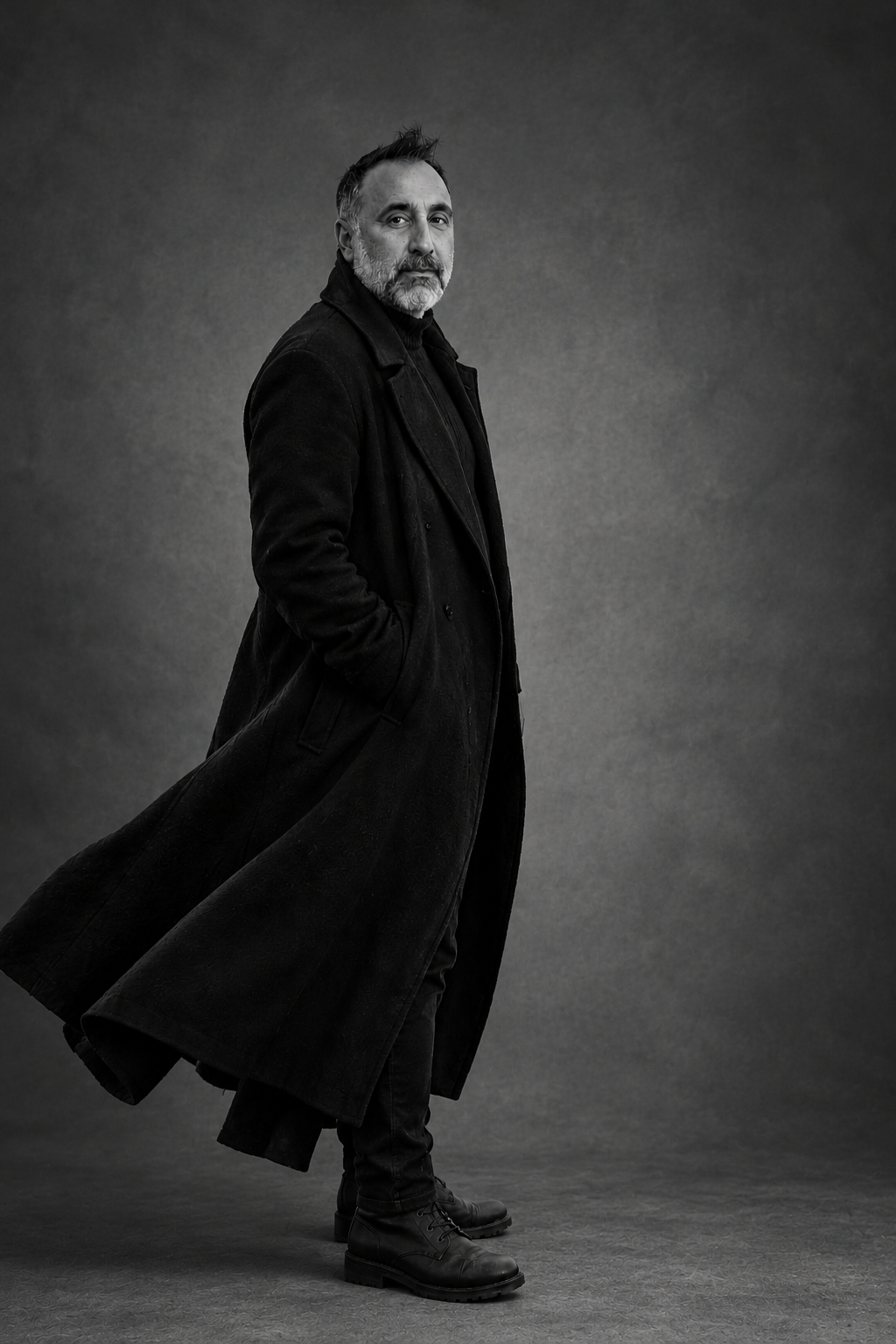
The monochrome image of a man and a raven became a natural starting point for “Disconnected.” There is a sense of contact between them, but also of separation, as if the physical presence of something doesn’t necessarily mean that a connection still exists. The absence of colour reinforces that feeling, stripping the image down to its essential elements.
For me, it introduces the album’s central idea: memories, identity and relationships can gradually become less tangible, until we begin to question what remains.
“Disconnected” is the first glimpse into that world, rather than an attempt to explain the whole story.