From Busted Gear to Desert Grit: Sleeping Fits Finds Humanity in the Noise
Punk Head: You recorded with “B-grade and busted gear in an untreated room.” Was that a deliberate rejection of perfection, or just a happy accident that became part of the sound?
Sleeping Fits: When I left the U.S. to live abroad in 2018, I sold most of my belongings, including my music gear. I’d been gigging for decades and had built up a good collection, but I never needed a sexy new Les Paul or a monster Bogner amp. I’ve always gravitated toward worn-out or overlooked equipment with character. I’d rather get a good sound from a cheap guitar than worry about scratching a mint-condition Strat.
I think using imperfect gear forces you to care more. It shows intent. You have to work around the limitations, which means you’re truly listening and engaging. A good song is a good song, no matter what you play it with.
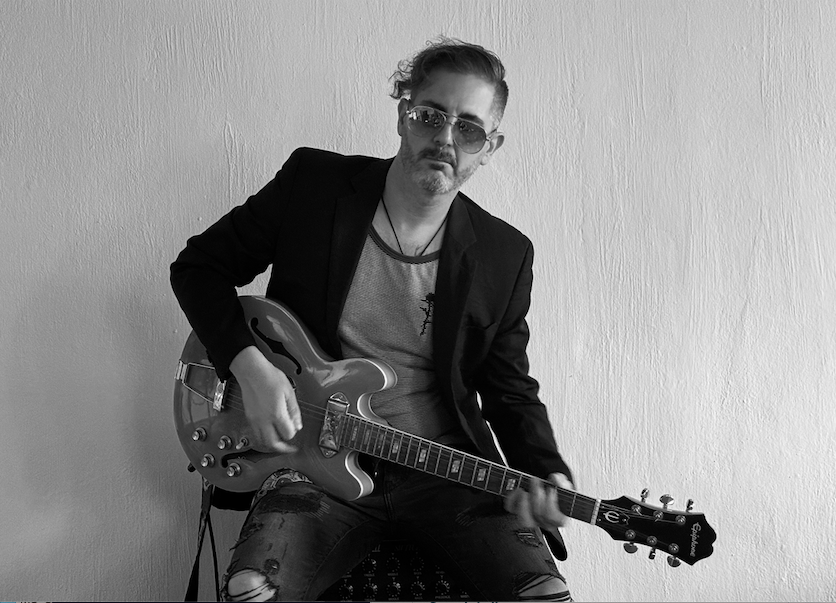
When I started this album, I didn’t have much equipment with me in Mexico, so I bought some used gear locally. One of the main pieces is an old Randall Switchmaster amp from 1980. It’s weird—there’s an air horn next to the speaker, and it’s LOUD. You can hear it all over the record. My main guitar was a beat-up Epiphone Casino Coupe I bought dirt cheap here. When I got it, it was caked with grime and one of the pots didn’t work. I brought it back to life, and I love its punchy, wooden tone.
Punk Head: The album mixes desert-rock heaviness with art-rock weirdness and pop hooks: three energies that don’t usually get along. Unravel this for us. How do you make chaos and melody coexist?
Sleeping Fits: I love contrast. When I first started writing songs as a teenager, I was taking jazz lessons, and I tried to meld these big, dense jazz chords with the sounds I heard on the radio—Soundgarden, Smashing Pumpkins, Nirvana. I took a real liking to Stone Temple Pilots because they were doing something similar to my own vision: smashing these really intricate, jazz-like chords into a hard-rock format with great melodies. Later, when I discovered Bowie, Failure, and Queens of the Stone Age, I realized they were doing it, too—this weirdness and quirkiness draped over the framework of satisfying structure and rhythm.
For me, the goal is to find that sweet spot where dissonance and catchiness share the same space. A good hook doesn’t have to be clean—it just has to hit emotionally. It’s a balancing act between chaos and control, which is kind of the core of what Sleeping Fits is about.
Punk Head: You’ve said the record explores “how we push each other apart in an overconnected world.” Was there a specific moment or observation that triggered that realization?
Sleeping Fits: It was more like a slow realization. I was in my teens when the internet came into common use, and I loved it—the entire world at your fingertips, right? Then came smartphones, and it felt like the future. There was no end to what we could collectively achieve. But we’ve kind of squandered that. Even well-intentioned human connection is mediated by algorithms. We’re constantly connected, but somehow lonelier than ever. I saw it in myself too—the doomscrolling, the short attention span, the way people perform empathy online instead of feeling it. And the way some people use it to their advantage.
There’s a song on the album, “Afraid of the Dark,” that’s pretty explicitly about that—the way we build our identities and relationships in a glowing screen, and the anxiety that sets in when the screen goes away.
Punk Head: There’s a lot of talk about tribalism and digital disconnection. As someone who’s now based in Mexico, has distance from the U.S. changed your perspective on all that?
Sleeping Fits: Oh yeah, for sure. Living abroad puts a lot into perspective. I mean, digital division and tribalism happen all around the world now. But when you step away from the immersion of U.S. culture and media, you start to see how it can be particularly intense and insular, especially when you're in the thick of it and it's constant.
In 2018, my wife and I relocated to Southeast Asia, and it became clear that a lot of my assumptions about the world, and my place in it, just weren’t true. Later, when we moved to Mexico, that became even clearer. I don’t live in a tourist bubble like Cancun or Mazatlan; I live in a community outside Guadalajara. People work, raise their kids, and chase security and satisfaction. It's the same stuff everyone everywhere does. At the risk of sounding trite, folks are just folks, all around the world. But it's so easy to look at a group of people "from away" and immediately think "They're not from my tribe; therefore, they must be bad." And then it's reinforced in a digital echo chamber. What's terrifying is that sometimes, that's by design.
I can’t point to any one country or culture and say it’s across-the-board “better” than the U.S.—that’s unfair and reductionist. But looking at the U.S. from the outside, it’s easier to see how divided people have become, how angry they are, and how digital connectivity has deepened that tribalism and sense of “otherness.” Not everything has to be mediated through a screen or a feed.
Punk Head: You mention influences from Bowie’s late career. What about that era of Bowie resonates with you most as a creator?
Sleeping Fits: When I say “late-career Bowie,” I mean everything after his ’70s and ’80s heyday—the ’90s onward. I love that period because he melded all his previous experimentations and leaned into being “David Bowie” in a more natural way. There was no longer a theatrical mask that he had to conform his music to; he was just making music. And it resulted in some of his best work.
The opening track on Reality, “New Killer Star,” starts with this rubbery melodic sound that feels like it’s stretching to hold the song together. It's weird and jarring. Then the chords and the groove come in, and it all comes together. It seems otherworldly, but when you pick the song apart, you realize the chords are just regular chords you'd learn in your first year of guitar lessons. I dig that tension—it rocks, but it’s restless. That balance between pop craft, groove, and unease is exactly the kind of thing I chase in Sleeping Fits. Music that moves you, but keeps you off-balance.