Feature: Ken Woods and The Old Blue Gang Decodes ‘Silent Spike’
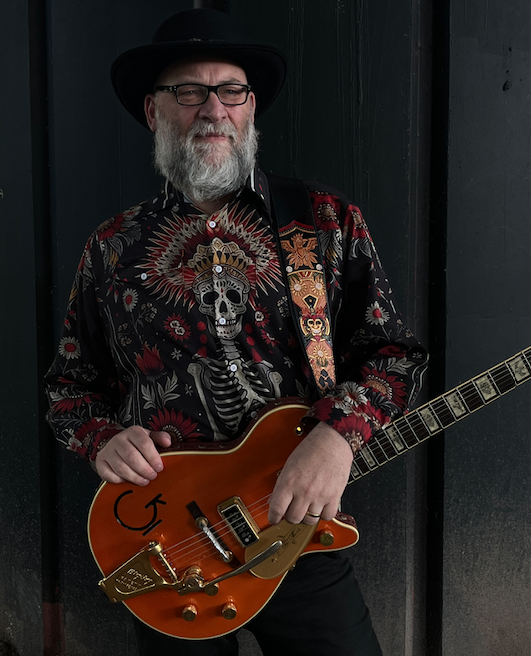
Credit: ©2025 Samuel Woods
How did you come up with the theme?
Eastern Oregon, where almost all of the events depicted in Silent Spike take place, is one of the remotest places in America. I lived and worked there for a number of years. It’s a stunningly beautiful region, where I met many wonderful people, but there is also a sense that the ghosts of history are close there. After I left, I began wondering just who those ghosts were – what was it that made the place feel so different. I did a lot of research on the history of the region, and found there were many tales to tell. Silent Spike is just one of those.
How did you approach the arrangement and composition of the music for 'Silent Spike?'
In general, my songs usually start with either a line of a lyric or a riff. Silent Spike started with books. Eventually, you find stories in those books that resonate, that you think could be the foundation of a story. Somewhere in there, I usually find a few phrases that have a certain innate music to them, and I start to build a lyric from there. In the case of this album, the lyrics all came first.
As far as the music, I wanted to reconcile two apparently conflicting goals. On the one hand, I wanted every song to have a totally unique and specific sound and vibe. If you listen to the great albums of bands like Zeppelin, Queen or late Beatles, it’s amazing how eclectic they are. I love that. And, on the other hand, I wanted the whole record to feel unified. If you listen to other great concept albums like The Wall or Tommy, you can hear themes that reappear throughout the arc of the story. This is something that goes way back to classical composers like Wagner and Schumann. Those little musical cells can be used to symbolise ideas, characters, places, and that’s all over this record.
Which song(s) from 'Silent Spike' do you think best represents your artistic vision?
That’s a tough one, for the reasons I mentioned above. The record is the result of a lot of time and effort going into making something that is as unified yet diverse as it can possibly be, and which embraces extremes of contrast at every turn. “Dead Line Creek” is very close to our hearts as a band. In spite of its daunting length, we play it live all the time. For me, it’s the distillation of my deep love and admiration for John Coltrane and Jimi Hendrix, filtered through a bit of Neil Young. The other epic on the record, “The Voyage,” is a much more ‘studio’ creation with over 100 guitar tracks – much more a love letter to Brian May/Queen and Rush in the 70s. And at the other extreme, there’s the stark simplicity and intimacy of “Gather the Ghosts and Bones” at the end of the record.
Can you tell us more about you as an artist?
I grew up in a household where there were few barriers between musical languages. The family stereo was always busy, and it was totally normal to jump from Shostakovich to Tony Rice to Louis Armstrong to the Kingston Trio on any given day. I started on acoustic guitar, then spent many years playing rock, blues and jazz as an electric player alongside my training as a classical musician. I’ve spent most of my life making a living in the classical domain with a great deal of joy and satisfaction, but I really missed improvisation and songwriting, and for me, it has been incredibly healthy and empowering to return to this music I love so much and find great musicians like Joe Hoskin and Steve Roberts to develop my music with.
Do you aim to convey any specific themes or messages through your music?
Like so many people I know, I have very deep concerns about the historical moment we find ourselves in. The modern world tells musicians our role is to entertain, but that’s not what I got into music for. And I reject the idea that art and entertainment are the same thing. The first thing I always want to do in music is to make it engaging to listen to, regardless of genre, style, mood. Music has to stand on its own as music. Beyond that, I suppose that I want to express ideas and feelings in music which help us to heal and reconcile. That helps us abandon the tribalism and short-termism that is destroying us. Projects like Silent Spike are intended not only to bring a sense of reckoning, but also to nurture empathy. Other things of mine can be more about learning to laugh together, to share joy, to recognise those things that can lift any of us, regardless of our background. Oh yes, and to hell with AI and corporate music!