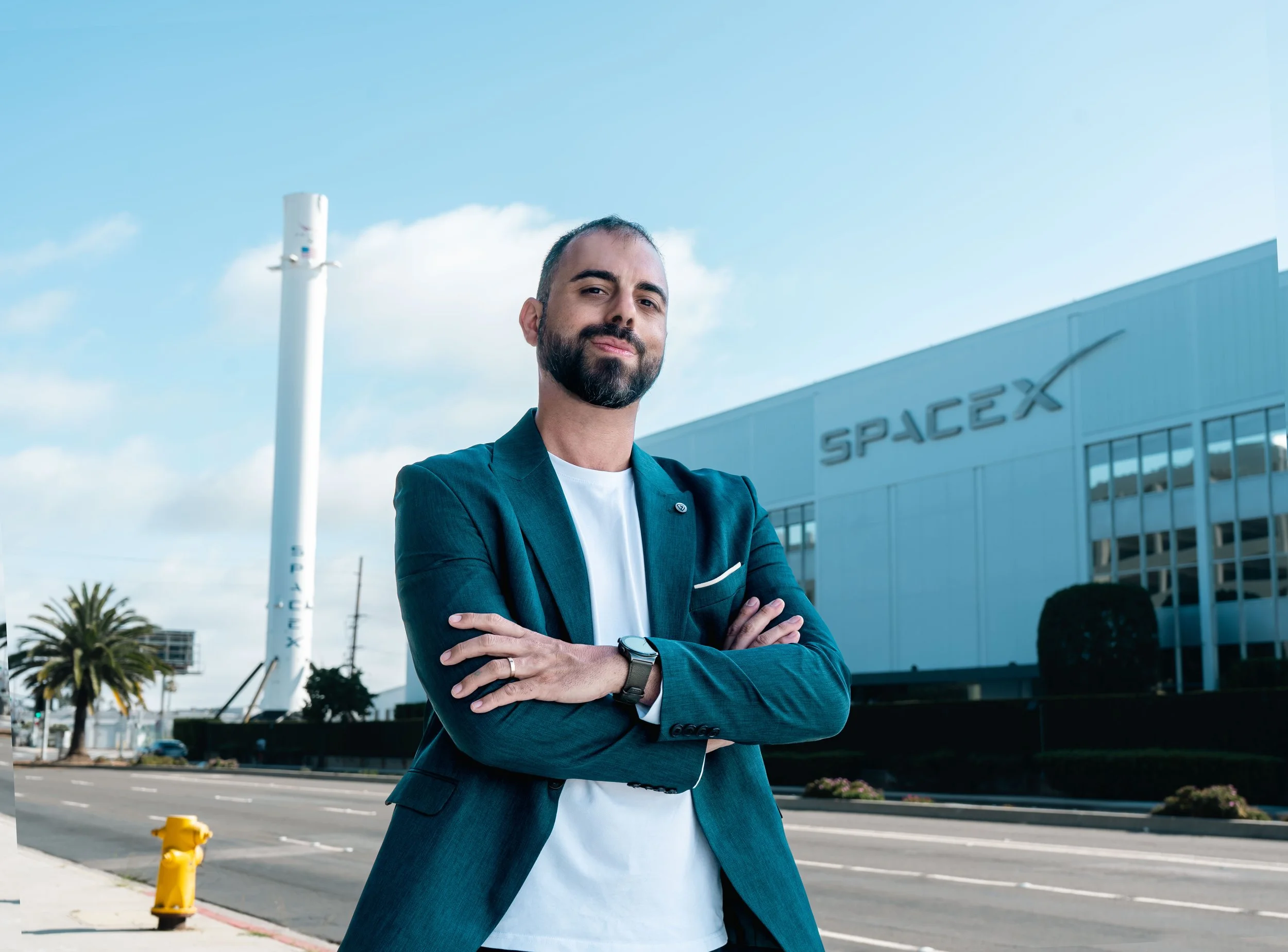
Punk Head: You describe the feeling of looking up and suddenly feeling small. Do you remember a particular night when that happened to you? What part of that experience did you try to bring to the piano?
Leonardo Barilaro: It started when I was nine, pointing my first ‘telescope’ (a binocular) upward, and hit me all over again years later standing under the Arctic sky in Sweden during my first stratospheric balloon mission.
Looking up like that strips away your ego in two seconds, you feel tiny in front of something vast and indifferent. What I tried to bring to the piano wasn't that smallness as fear, though, but the paradox inside it: the quiet realization that we are specks on a pale blue dot, and yet we still build machines and write music to reach the stars.
Punk Head: A signal traveling at the speed of light takes a full day to cross this distance. How did you begin turning something that difficult to comprehend into a piece of music? What was the first phrase you found?
Leonardo Barilaro: As an aerospace engineer, I can write 25.9 billion kilometers on a whiteboard, but the human brain doesn't actually feel that number, you only grasp it emotionally. I didn't try to translate the distance mathematically, I stripped everything back to an instrumental format, because sound and rhythm act as a universal lingua franca without words.
The first thing I found at the piano wasn't a grand cinematic theme, just a suspended, breathing harmonic motif with enough space around the notes to let the silence do half the work, like sending a pulse into the dark and waiting for an echo.
Punk Head: What did guitarist Marino Di Nino and drummer Andrea Giovannoli bring to the recording that changed your original idea of the piece?
Leonardo Barilaro: Starting solo at the piano, my natural instinct can easily lean toward pure introspection, floating in orbit alone. Marino and Andrea broke that solitude and turned “Sonic Sky” into a real ensemble dialogue.
Andrea’s drums gave the piece physical gravity and forward thrust, the momentum of an actual leap rather than passive drifting, while Marino’s guitar added grit, warmth, and harmonic breadth.
Once student Daniel Basurto Fojaco brought those layers together in the mix at NYUAD’s Gazelien Records, the track stopped being a quiet meditation and became a collective journey.
Punk Head: After recording during a parabolic flight, what did you notice about playing at a piano back on Earth that you’d previously taken for granted? Did that awareness stay with you during these sessions?
Leonardo Barilaro: Gravity itself. Every pianist on Earth is trained to relax the upper body and let gravity drop arm weight into the keys, it’s the invisible partner behind every chord we play.
In microgravity aboard that Cessna 182 during Zero Gravity, Note One, I hit proprioceptive drift: my arms involuntarily floated off the keyboard, forcing me to fire antagonistic muscles like my triceps and lats just to pull myself down to the instrument. Returning to a grand piano on Earth felt like rediscovering the sheer physical luxury of weight and resistance. That awareness never left me - now, every time my hands drop onto the keys, I consciously feel Earth holding me there.
Punk Head: What’s a question you hope the Space Art Lab will investigate that you couldn’t answer through either a conventional concert or an engineering experiment alone?
Leonardo Barilaro: At its core, it comes down to one question: Who gets to speak in Space? - and how human meaning and creativity actually evolve when you strip away the physical laws that shaped them. An engineering experiment alone can teach us how to survive up there, how to cold-weld a hull or track orbital debris, while a conventional concert can only imagine the cosmos from the comfort of Earth.
At the NYU Abu Dhabi Space Art Laboratory, we treat art as an active research instrument embedded inside real missions. That’s the only way to ensure our future beyond Earth isn’t just technically brilliant, but deeply human - because in Space, there is space for everyone.
Punk Head: Voyager’s journey has outlasted generations of technology and much of the world that launched it. What did making “Sonic Sky” make you reconsider about the lifespan of your own work?
Leonardo Barilaro: Voyager 1 is still whispering to us from 25.9 billion kilometers away on a 69-kilobyte computer from 1977. Almost every piece of tech we obsess over today will be obsolete in five years, yet that probe - and the Golden Record bolted to its side - has outlasted half a century of history.
Finishing “Sonic Sky,” a piece that matured over years before finding its final form alongside Andrey Prokhorov’s astrophotography, reminded me to stop measuring work by release cycles or algorithms. Across all that silence, music is humanity’s longest-living signal.
Our job isn't to chase attention this week, it’s to leave honest, 100% human work that can still speak long after the hardware that made it is gone.