Inside Lehmanski’s Independent World of Ideas and Contradictions
Punk Head: The press release almost treats the Hamburger Schule like a crumbling Altbau apartment. Do you feel protective of that tradition, or do you enjoy messing with its mythology?
Lehmanski: I don’t see the Hamburger Schule as a tradition that needs to be protected, because it was a phase that has come to an end. Through it, I discovered such wonderful bands as Blumfeld, Die Sterne, Tocotronic, or even Kante and Die Goldenen Zitronen, all of which I wouldn’t want to miss. The Hamburger Schule is part of my life and my musical identity — just as I cannot deny that I soaked up the music of The Cure back in the '80s.
Punk Head: Your songs seem to flirt with intellectualism while also distrusting it. Were you consciously trying to loosen up the “thinking person’s indie rock” formula?
Lehmanski: In the past even more than today, I try to create something that is somehow new. Of course, that cannot always succeed. But I am working on it. That is why I want to write lyrics that, in the best-case scenario, show through their very choice of words that they are about new ideas or thoughts — perhaps that seems like a flirtation with intellectualism. Even when I take an ironic swipe at something, it never results in pure comedy lyrics; there is always a serious background. That is why I think I am probably contributing to making sure the formula of 'indie rock for thinkers' will endure for just a little while longer.
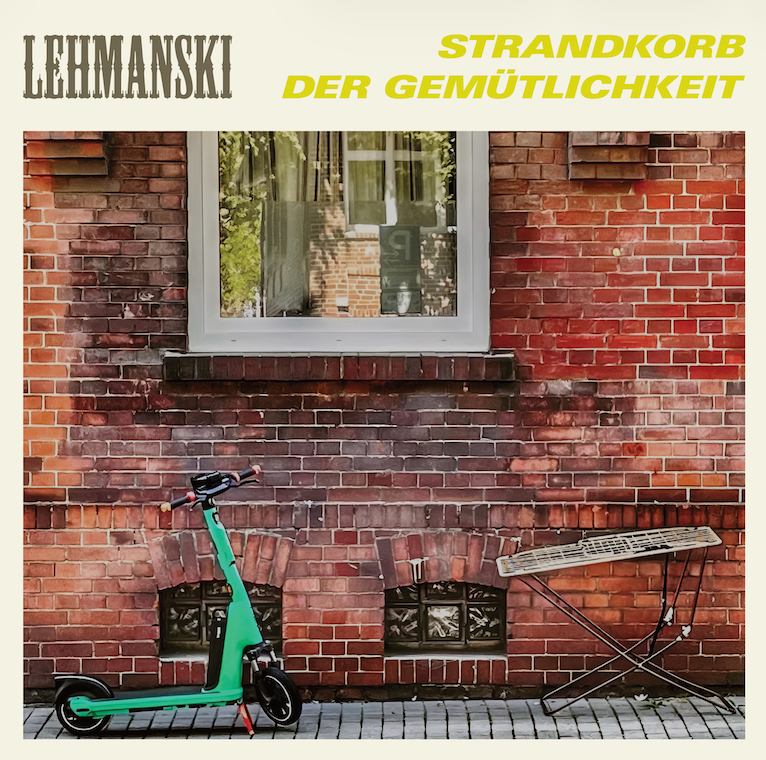
Punk Head: “Strandkorb der Gemütlichkeit” is such a specific image. Cozy, slightly ridiculous, maybe even defensive. What made that title feel like the right umbrella for the record?
Lehmanski: There is so much room for interpretation in this composition — title and cover — that I knew very quickly: Yup, that’s the title of my next album, and it’s not going to change. I am a little worried, however, that the title could be misunderstood. But in combination with the cover artwork, there shouldn't really be any doubt, right?
Punk Head: A lot of contemporary indie music either leans heavily into irony or completely rejects it. Your work seems to sit somewhere more unstable in between. Is that balance intuitive for you?
Lehmanski: My lyrics are definitely very intuitive. When it comes to the balance between irony and sincerity, I haven't really picked a side. I feel drawn to both, which might make the lyrics difficult to understand. But I suppose that’s something I have to live with.
Punk Head: The record sounds surprisingly expansive for something largely made in a living room studio. Did the DIY setting create limitations, or freedoms?
Lehmanski: Of course, recording in a studio is something special. I really enjoyed that, especially in the '90s with the band Whoa!. But being able to record pretty much everything at home nowadays has huge advantages. I can just get started whenever I have the time for it. It makes you independent.
Punk Head: You’ve been releasing music independently for a decade. At this point, does independence feel ideological, practical, or simply natural?
Lehmanski: Yes, that's right, I started my label Mofapetra-Records back in 2016. Since then, I’ve released not only new material but also a few older tracks through it — like from the aforementioned band Whoa!. Being able to just put things out like that gives me an immense amount of freedom because I don’t have to ask anyone for permission. And as a result, it feels somehow completely natural, or even normal. I do it because I can. And that is definitely a huge stroke of luck!