Jared Bond On the Making Of “Gross”
What was the creative process like for this particular song?
This one was such a blast to make. I knew right away that the word “Gross” would be a striking title—something that would look bold on a setlist and instantly make people curious. Around that time, I was reflecting on some pretty heavy themes: wealth inequality, the way violence is sometimes met with indifference (or even celebration), and the sheer appetite for power and greed that drives so many people in charge.
I’d also just watched The Substance with Demi Moore and Margaret Qualley, and the film’s way of making pleasure feel nauseating really stuck with me. I wanted to capture that same unease sonically. So I leaned into dissonant chords, unsettling riffs, and tones that almost make you queasy. Once I found the verse progression, I couldn’t stop playing it—it had this vibe reminiscent of Elliott Smith that made me smile. The chorus danced between major and minor scales, which gave it that creepy, crawly edge, like worms crawling out of a politician's or CEO’s mouth.
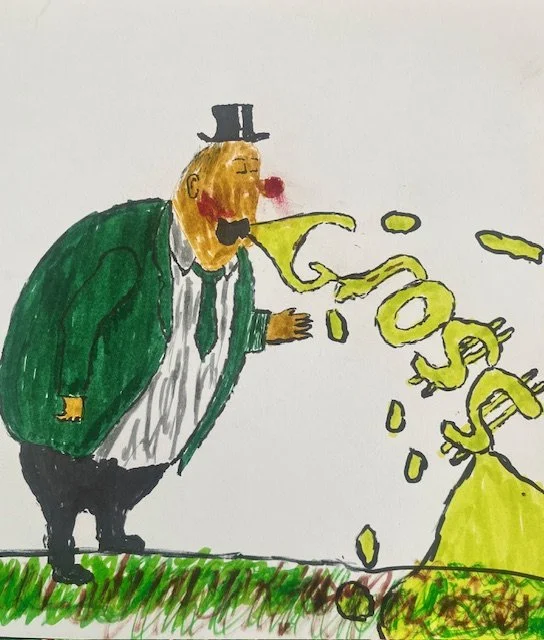
Lyrically, I had this grotesque figure in my head—part Dennis Quaid’s revolting character from The Substance, part real-life billionaire politician caricature, take your pick of which one, and part health insurance CEO. I imagined the amalgamation of these figures drooling onto a bib, blood dripping down their chin, just gorging themselves at the expense of other people’s lives. That imagery made the words flow quickly. The bridge came last, right before recording with Joel Nanos, and that’s where I decided to be completely direct: “If you think this is about you, well it probably is.” That line was my way of aiming the spotlight exactly where it belongs. I also loved getting to play a harpsichord on that part.
Were there any challenges or breakthrough moments during the songwriting process for “Gross?”
Yes. I grew up with laying the drums—I spent years on tour as the drummer for Josephine Collective, opening for The Used, Story of the Year, and Angels & Airwaves, and playing festivals like Warped Tour and Bamboozle. I loved every second of being on the road, but I wasn’t singing my own songs yet. Deep down, I knew I wanted that voice.
So with “Gross,” the big breakthrough was taking that risk on guitar. I wanted a completely unhinged solo after the bridge, but solos aren’t really my comfort zone. Then it clicked: the uglier and sloppier it got, the better it served the song. Joel Nanos (who produced the track) helped stitch together the chaos—stray notes, dead strings, messy timing—into something that felt like the song itself was falling apart. And that ended up being one of my favorite parts of the whole recording.
Is there a particular message or theme you hope listeners take away from “Gross?”
At its core, “Gross” is about my disgust with greed, power, and the way the ultra-wealthy consume at everyone else’s expense. But I’m not trying to change anyone’s political views with a song. For me, it’s more like an exorcism—it’s how I process anger and frustration.
If listeners hear it and feel the same fire, great. If they just enjoy it as a cathartic, creepy jam, that’s great too. Either way, it’s about connection—finding joy and release through and in spite of the ugliness.
How has your cultural background influenced your music?
I grew up in a conservative Christian home, so my first big musical influences were bands like DC Talk, Carman, and Audio Adrenaline. At the same time, my parents had Beatles vinyls that I spun constantly. My older brother opened more doors—he took me to see Steve Miller Band when I was in first grade, and introduced me to Hendrix. The first time I heard “Fire,” I knew I wanted to play drums. These influences planted a unique mixture of seeds.
From there, I found bands like MXPX that blurred the Christian/secular line, and eventually dove into Midwest emo with The Get Up Kids and The Appleseed Cast, both local heroes in my area. By high school, I was fully immersed in counterculture music because it felt deeper, smarter, more alive.
That path led me into Josephine Collective, where I spent years drumming full-time, touring the U.S. with huge bands and playing massive festivals. I was living the dream in so many ways—traveling, performing, sharing stages with my heroes. But I also felt this itch. As amazing as it was, something felt incomplete unless I was singing my own songs. That realization eventually pushed me to step forward as a songwriter.
What are your long-term goals as a musician, and what steps are you taking to achieve them?
My practical goal is for my music to sustain itself—ideally to support my family alongside my work as an ICU nurse. I love being a husband, a father, and a nurse, and that balance is really important to me, but I want my art to stand on its own feet financially too.
I am playing a show on October 9th at The Ship in Kansas City. After that we’ll see where it goes. I hope to continue writing and creating when the mood strikes me.
But my dreams? Those are wide open. I want to travel the world again, this time with my own songs at the center. I want to play major festivals, get film placements, and live a life where making music is both my passion and my livelihood. I’ve been close before—I’ve seen the inside of tour buses, the chaos of festivals, the thrill of the stage. Now I want to chase those same heights, but on my own terms, with my own voice. As long as it never turns gross, I’ll be happy.