Reinis Jaunais Is Always Somewhere Between Land and Sea
Punk Head: The title VEST means “to lead,” “to guide,” or “to take along.” Who or what is actually doing the leading on this album?
Reinis Jaunais: I hope the music itself is leading the listeners! It certainly leads me: across lands, over the seas, and sometimes out into space if I close my eyes on stage. I believe that if I feel like I'm flying when I play, there are probably some people in the audience whom I can take along with me.
Punk Head: You divide the record between “Seaward Bound” and “Landward Bound.” Was that distinction there before the music, or did the music reveal it to you?
Reinis Jaunais: It’s a bit of both, honestly. I've had the concept in mind for a long while, though a few of the compositions are earlier than this idea of labelling A and B sides of the vinyl as “Seaward Bound” and “Landward Bound.” This idea came to me during the countless hours I've spent driving from one city to another on tour. Travel inspires me to compose new music, and I enjoy sharing those experiences with the audience when they're keen to listen. But if I feel they’re more in the mood to dance or meditate, I talk less and let the music speak. When I was first starting out, I was sharing the stage with many international artists who were passing my home city Riga. For some of them I started to book DIY tours in Baltics and share the stage with them. Once, a Canadian songwriter told me: 'Musicians make the audience fall in love with the artist in-between songs, not during them.' That somehow stuck with me. I value that connection with the crowd very much.
Punk Head: There is a lot of movement in these titles: storms, drifting, horizons, winds. Were you trying to write an album that physically moves?
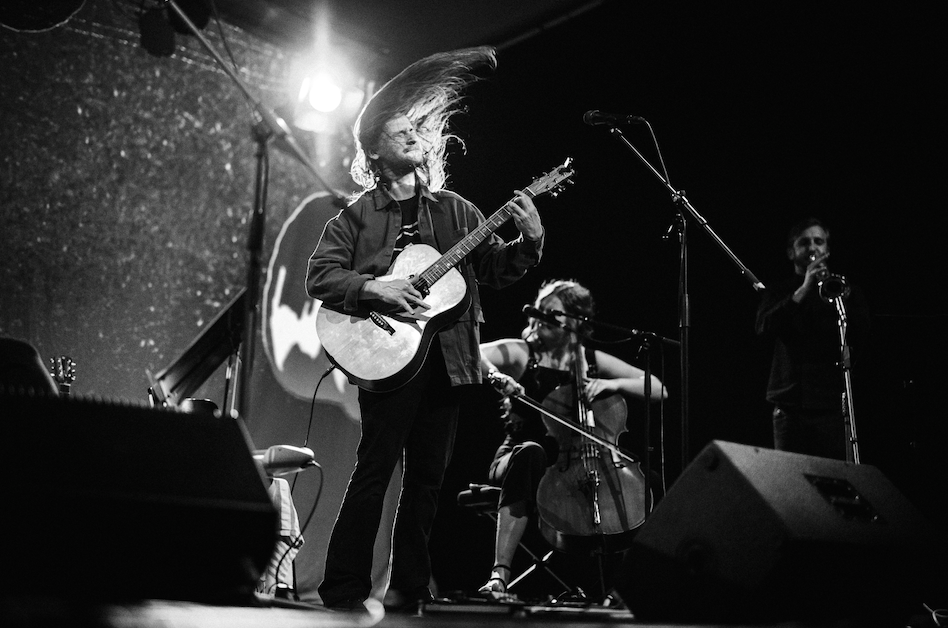
Reinis Jaunais: I certainly hope this album physically moves! That’s why we recorded it live, with all the instruments in the same room, including the drums. All of those sounds were captured analog on magnetic tape. There was some serious microphone bleed going on, especially from the drum kit, since the studio room isn't huge. But that belongs to the live sound that people can hear in the album. Once we finished soundcheck and made sure everything sounded right, we kept it to a maximum of three takes per song. I am so lucky to have the opportunity to play alongside such highly skilled instrumentalists as Janis Rubiks (double bass), Andris Buikis (drums), Zane Lasmane (kokle), Erna Orn Daugaviete (cello), and Harijs Locmelis (trumpet). Each of them is well-known locally as both a solo artist and a composer. I constantly have to practice to keep up with them. As Erna said when we first started rehearsing with Janis and Andris four years ago: with a team like this, it’s possible to move mountains. Later I invited Harijs to join us for our previous album Nest, as I was blown away when listening to his band Aston Kais. Zane joined our ensemble one and half years ago, as she surprised me with her exceptional playing that makes folk music sound really contemporary. As soon as she joined us, she got involved in the organisational tasks of our ensemble too, which is a big help.
Punk Head: The kokle and guitar are obviously very different instruments. What happens when they stop behaving like representatives of “traditional” and “modern” music and simply become two voices?
Reinis Jaunais: I actually believe that the kokle doesn’t necessarily need to be associated with folk music. To my ears, it’s just a really cool-sounding instrument that can fit into any kind of music. I use it in drone, free impro and noise side projects, like Not Not Jazz and DZZ. At the same time, I am a big fan of global music, so I do like to incorporate a bit of that folky sound that partly represents the place where I was born and raised. Even though I tour internationally a lot these days, I still spend most (or at least a big part) of the year in Riga. I especially try to avoid traveling during the summers, because I love cycling to my favorite bars, going to local festivals, and growing tomatoes and other vegetables in the greenhouse with my wife and our kids. But getting back to the question about the two voices: these instruments sound so different from each other that almost anything you play on them together will fit well. For instance, they don't compete in the same frequency spectrum. You don't necessarily need to play folk melodies on kokle. In fact, I’m always trying to seek out new sounds rather than replicating older ones. That said, I love traditional music, too. But I always encourage people not to mix up 'traditional music' with a conservative lifestyle.
Punk Head: “Vientuļie koki / Solitary Trees” feels almost like a visual image translated into sound. What did you hear before you knew what the piece was called?
Reinis Jaunais: In many areas along the Baltic Sea, including Latvia, a tree growing in the middle of a field, or a solitary tree, is an integral part of the landscape. Today, due to intensive land use, such trees are becoming increasingly rare. Every solitary tree has its own story. It is a bearer of memory for a specific place. At the same time, an ancient, solitary tree in a field is an oasis of biodiversity. Its hollow trunks and branches become a habitat for birds, bats, insects, mosses, lichens, and many other species. My wife Laima Jaunā is an artist and upcoming landscape architect. She is planning to make an art project about Solitary Trees, with photos, visuals, etc... I composed this composition partly for this project. She also made the artwork for this album, as well as visuals for live concerts.
Punk Head: You have spent a great deal of time touring outside of Latvia. Does being away from home change the way you hear Latvia?
Reinis Jaunais: I wonder whether distance itself has become part of your compositional process, particularly on an album so preoccupied with traveling between sea and land.
To be honest, I started to appreciate the beauty of where I'm from once I began traveling abroad for longer periods. There is something very cool about having four distinct seasons here, too — watching nature go to sleep, seeing things die off, and then watching life start all over again after a cold winter. At the same time, every single place in the world I’ve traveled to is beautiful in its own unique way. But nothing beats having a drink with the friends you grew up with.