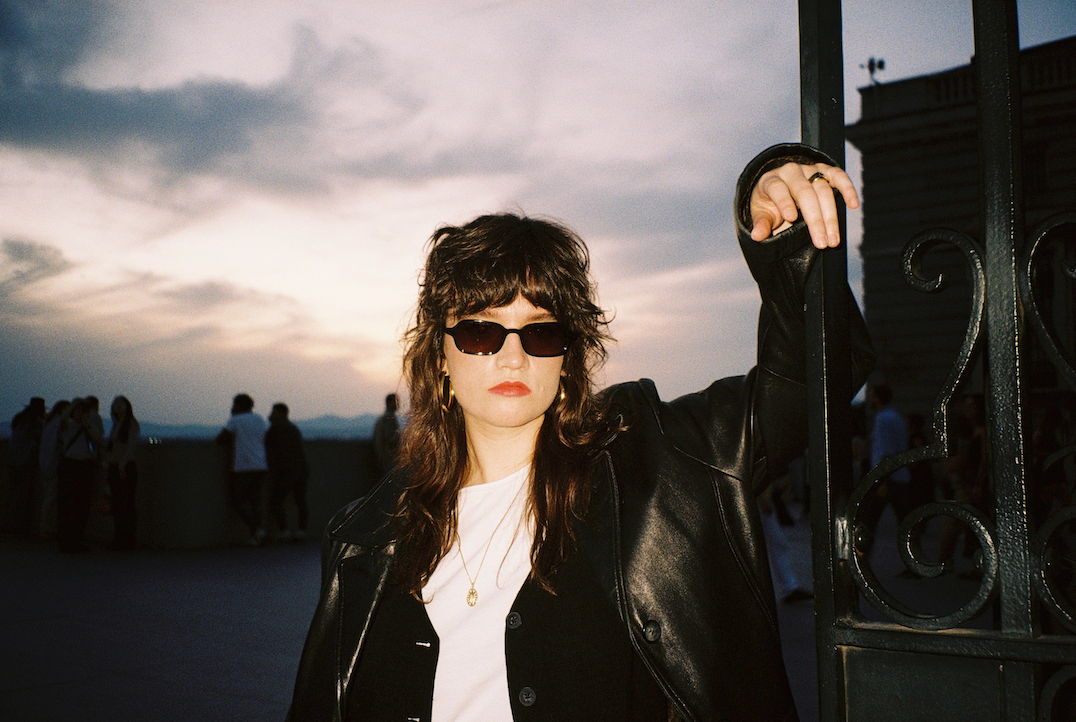
Punk Head: You call Vagío del 62 “a fist on the table.” What were you finally angry enough to put your fist down about?
Santa Ana: I think that, just as we talk about the progress we have made thanks to feminism, particularly among younger generations, we also need to talk about what other generations are doing. Because when we reach that stage of life ourselves, although there will still be work to do, the path will already be clearer for us, because they will have removed the obstacles along the way.
More than anger, it came from a need to express gratitude and recognition for this generation. The rights we women demand are no longer just about things “out there”: equal pay, equal opportunities to access senior positions, an equal division of domestic responsibilities… We are also demanding the right to feel vulnerable and to have someone there to catch us when we fall; the right to be heard and cared for; the right not to have to cope with everything; and emotional availability from others, among other things.
When it comes to all of this, my mother’s generation is the one making a stand and reshaping the way we build relationships. They are demanding from others the bare minimum that has been expected of them all along: that we look after one another’s dignity.
Punk Head: Why did a fictional woman become more useful to you than simply writing an autobiographical album?
Santa Ana: When I started making this record, my intention was to tell a story that all women could identify with: to talk about what we might have experienced at each stage of our lives (in broad strokes, because there is so much more to say), and the place society had assigned us, or the role it expected us to play.
As I worked on the album, and given where the record’s “turning point” fell, I realised that, although any woman could see herself reflected in it, the story had a great deal to do with my mother and her friends. They were setting boundaries at a point in their lives that felt less immediate to women of my generation. Maturity is a stage when you are supposed to have found some stability, a quieter period of life — although, of course, that does not mean you stop learning. Your experiences, and the way you feel about or understand certain things, are different from what they are at 20 or 30. You think you have finally reached a place of comfort, and then that famous thing happens: “the questions change”. You would rather pay the price of changing your life and reshaping your relationships so that you can feel your life is truly your own than carry on living the life you have spent years building. At 60.
My generation has not reached that point yet, and when we do, it will be different for us because they will have walked the path first.
Punk Head: There’s a striking tension between flamenco’s emotional directness and the harder language of distortion, psychedelia and electronics. What happens when those sounds are allowed to argue with each other?
Santa Ana: To me, it feels like reaching a state of ecstasy. At least, that is how I experience it personally. It is what I felt the first time I listened to Triana or Califato 3/4.
La hondura has distortion; it is psychedelic, and it is driven by compás, just as electronic music is driven by the pulse. I feel these genres accompany and complement one another, producing something wonderful. They share so many similarities, rooted in something visceral and born out of our deepest human needs: a quejío (a flamenco cry), anger, breaking down in tears, pleasure, the body’s internal and external movement… These are the kinds of things flamenco, psychedelia, distortion and electronic music can all express.
Punk Head: You grew up around music but eventually became afraid of performing. Does stepping onto a stage now feel like reclaiming something, or like confronting an entirely different fear?
Santa Ana: My stage fright stems from having been “forced” to perform as a preteen, at times when I had explicitly said no. Nobody told me, “You have to do it”, but they would keep asking and insisting, again and again, until I eventually said yes. When the day came to go on stage, the only reassurance I received from the teachers who were supposed to be looking after me was: “Don’t get nervous; there’s no point in that.” I should say that I do not blame them for this. I think we still have a great deal to learn about how to respond emotionally to people who find themselves in particularly vulnerable situations. After the last time it happened, I was so badly affected, both emotionally and physically, that I swore I would never sing or play music in public again.
When I decided that perhaps making music was what made me happy, and that this meant performing in front of people, the whole issue kept circling around in my head. But going to therapy, spending time in spaces where people play and sing together, connecting with one another through music, and having a safety net and a band where we can support and catch one another when we fall — all of that feels like a blessing to me.
So I think it is now time to give a new meaning to what it means to put yourself out there in front of an audience. For me, it feels like reclaiming the pleasure and the joy of it all.
Punk Head: There’s a fascinating lineage here, from Triana and Lole y Manuel to Morente, El Barrio and Derby Motoreta’s Burrito Kachimba. What does “rock andaluz” mean to you now, rather than what it meant in the seventies?
Santa Ana: The 1970s saw the emergence of Andalusian rock. It was the first time flamenco had been fused with rock and blues. What made it so remarkable was that music deeply rooted in tradition, and widely regarded as profoundly traditional, was being blended with music that not only belonged to a different genre but also came from other countries — and this was happening at a time when Spain was under a dictatorship.
It was a breath of fresh air amid the apathy brought about by almost 40 years of an authoritarian, repressive system. There is no need to spell out how revolutionary that was.
That, at least on the surface, is the fundamental difference between Andalusian rock in the 1970s and Andalusian rock today. Artists making this music now do not have to worry about the consequences of addressing certain subjects in a song or breaking with convention in order to create something new.
Then, as with all musical genres, Andalusian rock has continued to evolve over time. Bands such as Derby Motoreta’s Burrito Kachimba and Quentin Gas y los Zíngaros have also incorporated elements from other genres, including electronic music. Today, Andalusian rock — already a fusion in its own right — is being blended with yet more different styles.
My own record is a good example: I think Weyes Blood’s influence on me is quite noticeable. She is one of my favourite artists.
Just as globalisation is present in every aspect of our world, it is present in music, too.
Punk Head: If your mother’s generation was not raised to be free, what does your generation inherit from the freedom they fought to create?
Santa Ana: My generation inherits an open path in areas where theirs was blocked and they had to break the chains. We get to walk peacefully along smooth paths where, in the past, we might have been scratched by any bramble along the way. We inherit an awareness of the struggle for the place that belongs to each of us.
We also inherit the understanding that caring for others is not tied to any one gender, but that everyone has a responsibility to provide care and a right to receive it.