Scapegoat, Synths, and Heritage: How Salwa Channels Ancestral Trauma into Dark-Electro Alchemy”
Punk Head: You describe this project as three years in the making—was there a defining moment that made you realize it needed to exist now?
Salwa: I wrote the song in August 2023, after having a rough few years trying to come to grips with my identity within my family and my life generally. It led me to reflect more broadly on everything my family had been through: from my grandmother Salwa being forced out of Palestine, to my father’s life in Beirut before I was born, and finally my own time growing up in Beirut. There is a powerful metaphor within the scapegoat story that originates within that part of the world where I am from. At first, the song was pretty stripped back and raw, with bassy piano and growling vocals. Then two months later the genocide in Gaza began and I realised it was now more than ever I needed to embrace all of my Arab identity culturally and emotionally, so I turned it into a darbuka fuelled, dark-electro dance track.
Punk Head: There’s a sense of ritualistic research behind your work—from studying mythology to interacting with goats. How do these tangible, almost performative research methods feed into your creative intuition?
Salwa: I’m an actress, performer and a nerd so this combination and approach to my work is not unusual for me. I like to know everything there is to know about something that interests me. I wanted to really dive into the performance element of what it would mean for a human to transform themselves into an animal. I did a lot of animal work in my acting training - it was always my favourite part of creating a character. Following that with the studying of ancient texts, reading the Leviticus from the Old Testament, for example, just gave me such an insight into how old the story is. These tales are passed down over centuries and form the basis of so much trauma and neurosis.
Punk Head: What was it like transforming yourself visually into a “human-turned-goat AI” and how did that shape the way you see yourself as an artist?
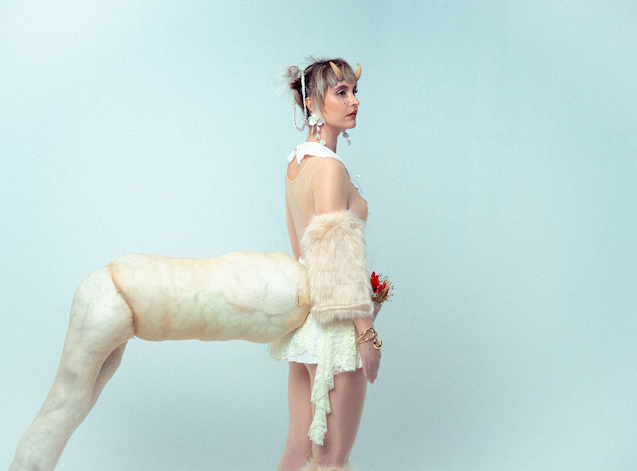
Salwa: Well, this was the best part. I had this weird image as a reference for what I imagined the Goat piece I would wear to look like. I didn't want it to be realistic but more like AI gone wrong. I showed and described it to my creative producer, Jakub Kotwica, and he just went: hell yeah, I can build this! So we tried a few different methods including moulding the piece to my lower back. The transformation itself would only be complete with the costume element but I wanted to push myself as an artist and performer to reach different heights through learning the movements of Goats. I spent a lot of time with and studied a particular goat in Spitalfields City Farm, called Chewy. She was spritely and tall like myself, so she gave me a lot to work with.
Punk Head: If someone walked into your visualiser without knowing the story, what’s the first feeling you hope they leave with?
Salwa: I honestly just hope it gives people the chills while also challenging their expectations. We see a lot of the same kind on visual content and hear a lot of similar music. I'm trying to do something different and weird by combining things that shouldn't or wouldn't normally go together.
Punk Head: Your heritage spans Lebanese, Palestinian, and Scottish cultures. How does this layered identity inform both the sonic and visual storytelling in this release?
Salwa: I take a lot from all sides of my heritage and I’m so proud to be half Arab, half Celtic. An incredibly bad ass combination, with both places having so much history. It isn't hard to draw parallels. Directing the visualiser for this track meant I could link a lot of things back to both cultures aesthetically, and of course, both cultures have sherpas and have deep connections to goats. In terms of the sonic elements, I grew up listening to the darbuka, with my father being a gifted player so it feels natural to want to explore these sounds in my own music.