Sergiy Bolotny Wants Music to Confront What Beauty Cannot
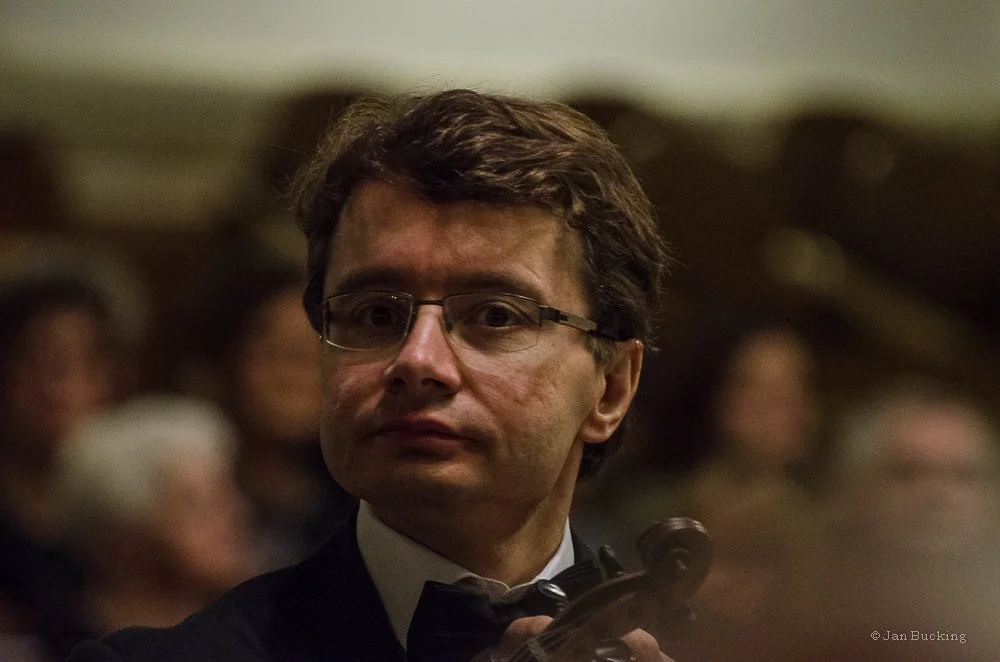
“I wanted to share the personal heart behind this work:
This piece is my immediate reaction to the war in Ukraine—a prayer to God and a direct plea to those who hold the power to stop this devastation: Please stop the war.
In the music, I deliberately contrast the fragility of an ancient Ukrainian folk melody with a relentless, mechanical pulse. It reflects the quiet exhaustion, grief, and resilience of those living through this reality every single day.”
Punk Head: You take a violin, an instrument almost synonymous with warmth and human expression, and make it sound mechanical. Why did beauty feel insufficient for this piece?
Sergiy Bolotny: This is the opening work of my cycle Three Echoes on Ukrainian Folk Themes:
Reflections: Oh, Human Destiny
Intermezzo: Why, Why, My Dear Land?
Nightingale’s Farewell Song: Farewell, Dear Country Home
In each piece, I weave a traditional folk melody into my own musical framework—specifically a mechanical, minimalist motion that mirrors the repetitive nature of fate and how destiny unfolds in our lives.
In this first movement, that repetition embodies profound grief and desolation. It speaks to the fate of those who have lost their loved ones or their homes—those caught in the midst of war, living as refugees. As the traditional song says: "Oh human destiny, fate is blind..."
In the second piece, which is lighter and more cheerful, the mechanical pulse mimics the patterns of nature—a steady wind or a flowing stream—evoking quiet contentment.
In the third and most tragic movement, the repetition becomes the persistent call of a nightingale at dawn, underscoring the heartbreak of an exile who must leave home behind, or perhaps face an even darker loss.
Punk Head: Why a machine? What can mechanical repetition express about war that a conventional musical lament cannot?
Sergiy Bolotny: It expresses the inescapable nature of hopelessness. We all know that feeling on an everyday level: you have an important exam, concert, or meeting early the next morning, but your neighbors are throwing a loud party and you cannot sleep. Or you suffer from a relentless headache—you take medication, but the throb simply continues without relief.
That persistent, unyielding rhythm is what drives my piece. Beyond conventional aesthetics, my goal on the violin is to portray psychological states and real human emotions. This repetitive motion demonstrates that music does not always exist merely to sound "pretty"—it must sometimes confront harsh realities.
Punk Head: There’s no heroic violinist battling the machinery here. The folk melody almost seems too tired to resist it. Was that powerlessness important to you?
Sergiy Bolotny: Yes, exactly. When the folk melody emerges from the relentless motif of destiny, it sounds hollowed out. My aim was to capture the beauty of emptiness. It lingers like a shadow, a faint silhouette, a distant memory, or a fragile glimpse of childhood.
It is like that state after hours of weeping, when you have exhausted every tear and are left with no strength, no emotion—just complete, quiet numbness.
Punk Head: You’ve previously used Ukrainian themes in works that engage with lyricism and virtuosity. What changed when you approached Ukrainian material through this much darker lens?
Sergiy Bolotny: This represents a second creative path for me. As a composer, I want to explore contrasting musical worlds: on one hand, the virtuosic, sparkling traditions of Paganini and Kreisler; on the other, the dark, minimalist, and contemplative aesthetics of Philip Glass and Arvo Pärt. The cycle Three Echoes on Ukrainian Folk Themes, as well as my forthcoming autobiographical cycle Four Lyrical Pieces, belong to this second path.
Ukrainian folklore carries a deeply tragic undercurrent shaped by a turbulent history—centuries of war involving Russia, Poland, and the Ottoman Empire, alongside the historic suffering of Ukrainian farmers and laborers. Exploring that darker facet felt both natural and necessary.
Punk Head: If the traditional melody represents something inherited, and the machine represents something relentless and contemporary, what happens in the space between them? Is that tension where you believe the real subject of Reflections lives?
Sergiy Bolotny: I believe that every genuine work of art—whether a composition, a painting, or a novel—inhabits that "space between." It brings us to the most vital, difficult question of all. Even the most abstract music has a story to tell, a truth to reveal, and a wound to heal.
Here, my goal was not simply to compose attractive music, but to reflect reality: a fragile folk melody intertwined with an unyielding, automatic motion. That tension creates a third dimension—a doorway we can step through to transcend the noise. Music offers a refuge and a disconnection from a fractured world marked by dishonesty and compromises with evil.