Story, Identity, and Momentum to Justify the Ink: Storm Boy On ‘Beast Machine Theory’
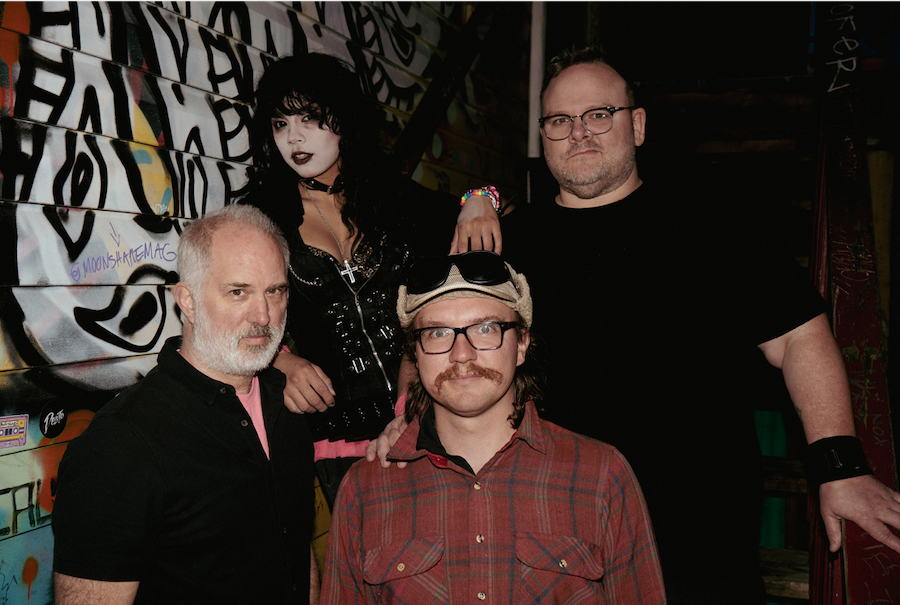
Credit: Photo by @FTPRADAA
Punk Head: You describe the band as “big,” which feels less about size and more about feeling. What does “big” actually mean to you in practice?
Storm Boy: I think you nailed it—it’s not about size, it’s about feeling. We’re pro-feelings, pro-emotions, and pro-accountability. Someone once described us as “hardcore for soft people,” and that stuck.
That shows up in lyrics that wrestle with time, responsibility, and the decisions we make—individually and together. The goal is to do that without being preachy or self-righteous, but with empathy. Because it’s hard out here. It’s hard feeling like your choices don’t matter, like you’re stuck choosing between eating and heating, like everything’s a loop you can’t break.
If there’s any value in what we do, it’s in reminding people they’re not alone in that.
And being a band with a wide range of experiences helps. We’re not all in the same place, but we’re in it together—and that shapes how we play, how we write, and how we show up for each other.
Punk Head: The album title suggests something mechanical but also alive. What does “Beast Machine Theory” mean to you, and how does that idea show up in the music itself?
Storm Boy: So, for those that don’t know, Beast Machine Theory is Anil Seth’s theory of our bodies being the basis of our self - these machines that we inhabit that lend us our ability to interact with the world around us are “beast machines.”
So, for us to expand on that, Beast Machine Theory comes from this idea that we’re all these biological systems—these “machines”—trying to make sense of the world in real time. The brain is constantly predicting, filling in gaps, reacting to signals that are already slightly in the past.
So what we experience isn’t exactly reality—it’s our best guess at it.
When you apply that to a band, it gets interesting. Four people reacting to each other in real time, anticipating what’s about to happen, adjusting on instinct. The way Kuba plays affects how I play, which shifts how Charli sings, which all feeds into how Jeremy hits. It’s this loop of expectation and response.
You could call it a shared hallucination. It works because we trust the pattern—and each other.
At least…we think it works.
Punk Head: The phrase “energy outweighs ego” is doing a lot of work in your description. Can you walk me through what that actually looks like in a rehearsal room when there’s disagreement?
Storm Boy: Honestly, we don’t argue much. There’s a level of trust here that’s rare.
If someone brings an idea in, the default response is “let’s try it.” Not debate it—play it. If it works, it stays. If it doesn’t, we move on. No ego, no scorekeeping.
Where “energy outweighs ego” really shows up is live. Mistakes happen—that’s part of it. What matters is whether the energy holds. Are we still locked in? Are we still connecting? Is what we’re doing resonating?
If we walk offstage sweaty from effort, not frustration, and look at each other like “that was fun,” then we did it right….and we do it right way more often than we don’t.
Punk Head: Recording quickly often captures instinct, but it can also lock things in before they’re fully understood. Were there moments on the record where you had to trust something you didn’t totally have language for yet?
Storm Boy: You can think about recording from two perspectives: the listener and the performer.
From the listener’s side, the recording becomes the definitive version. It’s the reference point—the truth. Those notes happen in those places, and that becomes the expectation.
As a performer, it’s different. A recording is just one captured moment. We play these songs hundreds of times—practice, shows, multiple takes—and the version that makes it onto the record is just one instance in time. Sometimes that includes little artifacts—mistakes, weird fills, things that weren’t planned but feel right. Those moments end up becoming part of the song’s identity.
So for us, recording is about capturing an interpretation, not locking something in permanently.
There were definitely moments on this record where we had to trust instinct before we fully understood what we were doing. “Always Bet on Black (and Pink)” is a good example—we’d never actually played it together before recording, just listened to a demo on the road.
When we got to the breakdown—the part where everything falls apart and builds back up—we had to figure it out in real time. That was probably the closest we got to frustration, but it was more about solving the puzzle than clashing creatively. Once we found the count, it clicked—faster than we expected.
The bigger challenge came later, bringing it into the live set. Because songs don’t stop evolving after they’re recorded—and honestly, they shouldn’t.
Punk Head: Touring tends to either solidify a band’s identity or crack it open. What have you learned about yourselves on this current run that you didn’t know when you made the record?
Storm Boy: We play a lot. I always joke that a weekend without a show is a weekend wasted, so we’re used to being around each other.
Touring just reinforces what’s already there. It gives us space to talk through ideas, share influences, figure out what we’re chasing next. Even when a song comes together fast, we usually have a sense of its direction before we hit record.
But the real thing we’ve learned? We actually like each other.
We hang out outside the band. We celebrate birthdays, cook for each other, go to shows together. That stuff matters more than people think. It’s the reason this works.
At this point, the world might just be stuck with us because we’re happy being with each other.