Punk Head: “PLASTIC ANGELS” takes aim at the pressures placed on women to look a particular way. Beauty standards are often presented as personal choices, even when those choices are shaped by wider cultural expectations. Where do you see the line between individual expression and pressure to conform, and how did that tension inform the song?
THE CUNNING LINGUISTS: That tension is at the heart of the song. We live in a world where women are constantly bombarded with images of what they’re supposed to look like, from social media filters and celebrity culture to the beauty industry selling the next miracle fix. The irony is that what’s presented as empowerment and individual choice can sometimes become another set of rules women are expected to follow. Plastic takes aim at that contradiction. It’s not about judging women for the choices they make with their bodies; it’s about questioning the culture that makes those choices feel necessary in the first place. When everyone is chasing the same ideal of perfection, individuality can get lost in the process. You can end up looking more like the image you think the world wants, while becoming less comfortable with the person you actually are.
Punk Head: There's a compelling connection between a song criticising artificial beauty and a recording process that embraces imperfection. Was that connection something you consciously recognised while making “PLASTIC ANGELS,” or did it emerge naturally from the way you work?
THE CUNNING LINGUISTS: I’d say it emerged pretty naturally from the way we work, rather than us sitting down with some grand artistic manifesto. We come from a punk background, and there’s a healthy suspicion of anything that’s too polished, too controlled or too concerned with getting everything just right. We like music that sounds like people playing in a room together, with all the energy, attitude and occasional train wrecks that come with it.
PLASTIC ANGELS takes aim at the obsession with artificial perfection, and we apply much the same thinking to our recordings. We’re not interested in sanding off every rough edge, correcting every little mistake or making ourselves sound like something we’re not. If there’s a bit of grit in the guitar, a vocal that’s hanging on by its fingernails or a rhythm that’s got a life of its own, we’re often happier leaving it there.
For us, those imperfections are part of the songs and so part of the band. They’re the musical equivalent of a face that hasn’t been filtered within an inch of its life. You hear the humans behind the noise, and that’s what makes it interesting.
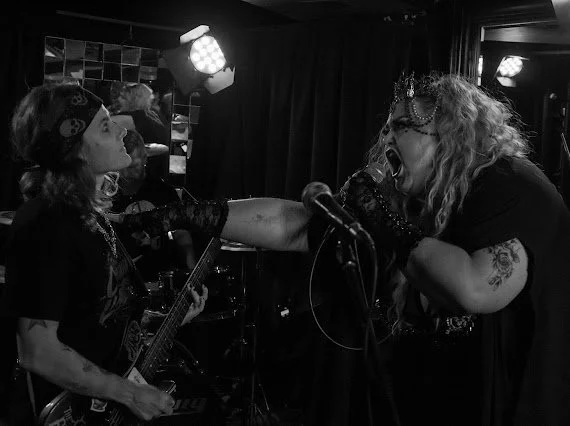
Our live shows are a big part of that philosophy, too. There’s an immediacy and unpredictability to playing live that you can’t manufacture in a studio. We want our recordings to carry some of that same energy. The sense that something exciting might happen, or something might go slightly wrong, and either way you’re along for the ride.
So while we didn’t necessarily set out to make the recording process a metaphor for the song, the two come from the same place: a belief that imperfections are not automatically problems to be fixed. Sometimes they’re the very things that make something authentic.
We’re not anti-beauty; we’re anti-the idea that everything has to be perfect. And frankly, if we started polishing all the imperfections out of The Cunning Linguists, we’d probably polish the life right out of the band.
Punk Head: You describe a collaborative songwriting process that begins with lyrics and develops through riffs, drums and vocal melodies. What happens when the three of you have different ideas about what a song should become, and how do you know when you've found the right direction?
THE CUNNING LINGUISTS: The biggest thing is respect. We’re all passionate about what we do, and we all have opinions about how a song should sound, but there’s no point being in a band if you’re not prepared to listen to each other. Everyone brings something different to the table, and sometimes the best ideas come from someone suggesting something you’d never have thought of yourself.
Our songs do often start with lyrics, and then we build them up with riffs, drums and vocal melodies, working through the different elements until they start to come together. It’s rarely an instant process. We fuck up more often than not but that part of the fun of creating music together. And we don’t take ourselves too seriously when we do. We’ll try things, pull them apart, change direction, revisit ideas and keep chipping away at them. Sometimes a tiny change makes all the difference; other times, you can spend hours going around in circles before something clicks or we just park it for another day.
The important thing is that nobody’s opinion gets dismissed. We’re willing to listen, experiment and give each other’s ideas a proper go. There’s no ego in the band! If someone thinks something isn’t working, we take that seriously, because ultimately we all want the same thing: to make a song we genuinely love playing.
And there’s one rule we’re pretty firm on: we have to be 100% behind a song as a band. If we don’t all agree that it’s something we want to do, we don’t do it. It’s not a majority vote, and nobody gets dragged along just to keep the peace. That might mean an idea gets shelved, or that we have to go back and work on it some more, but we’d rather do that than put something out that one of us doesn’t believe in.
You know you’ve found the right direction when the lyrics, the guitar, the drums and the vocals all make sense together, and you can feel joy when you play it. There’s a point where you stop analysing every little detail and start enjoying what you’re hearing.
We don’t necessarily get there quickly, and we certainly don’t always agree straight away. But we trust each other enough to keep working at it, and that’s the beauty of the process. Bit by bit, we get the song to a place where we can all stand behind it.
For us, a great song isn’t just one that sounds good. It’s one that all three of us believe in, and that shared conviction is what makes it a Cunning Linguists song.
Punk Head: You draw on musical traditions that have often given outsiders a way to challenge the status quo. What does rebellion mean to you in 2026, and how do you keep that spirit alive without simply repeating the gestures of earlier punk generations?
THE CUNNING LINGUISTS: For us, rebellion in 2026 is much the same as it was for the early punk bands: refusing to be told what to think, how to behave or what you’re allowed to say. Bands like the Sex Pistols, The Clash and the early pioneers of punk weren’t waiting for permission or trying to make themselves acceptable to everyone. They were reacting to the world around them, calling things out and making music on their own terms. That spirit is part of punk’s heritage, and it still matters.
But we don’t think you have to change your clothes, dye your hair a particular colour or spend your life trying to look rebellious to keep that spirit alive. Punk can become just another uniform if you’re not careful. You can end up following the conventions of rebellion rather than actually challenging anything.
Just like it was in decades gone by, there’s so much in the world in 2026 to stand up to, and just as much to stand up for. Whether it’s the pressure to conform, the obsession with artificial perfection, hypocrisy, injustice or the expectation that everyone should keep their opinions palatable, there’s no shortage of things worth challenging. And there are plenty of people, ideas and principles worth defending, too. Some people need a voice and sometimes you just need to scream Fuck You!
For us, rebellion is about being authentic. It’s about having something to say and being prepared to say it, irrespective of who it bothers. We’re not interested in manufacturing controversy just for the sake of it, but we’re equally not interested in watering down what we believe because someone might find it uncomfortable. If a song challenges an idea or makes people question something they’ve taken for granted, then it’s doing its job. We are expressing our opinion and believe we have that
We’re not trying to recreate 1977. The world has changed, and the things we’re responding to are different. What hasn’t changed is the need to question authority, challenge conformity and speak honestly about what matters to you.
Real punk isn’t about looking like a rebel. It’s about having the courage to stand up for what you believe in, stand against what you think is wrong, and not compromise your convictions just to make other people comfortable. If that bothers someone, well, we’ve probably got a song for them. Actually we will!
Punk Head: “PLASTIC ANGELS” makes your commitment to social commentary clear. But what else do you want The Cunning Linguists to be capable of? What might surprise people who assume they've already figured out your sound or your point of view?
THE CUNNING LINGUISTS: We want The Cunning Linguists to be a band whose songs actually matter. It’s not enough for us to write a catchy tune, get up on stage and have a good time, although we certainly intend to do all of those things. We want our music to mean something beyond the time it takes to play it. We want to give a voice to people who aren’t being heard, shine a light on the things people would rather keep hidden, and drag predators, bullies and those who abuse their power out into the open.
There’s an enormous amount of suffering and abuse in this world, and too much of it happens in silence. People are intimidated, marginalised or made to feel that nobody will believe them. If a song can make someone feel less alone, give them the confidence to speak up, highlight a cause that gets people involved, or help expose behaviour that needs to be challenged, then we’re making progress. We’re just getting started on screaming at the top of our lungs about these things.
The three of us are individuals, and we don’t necessarily see every issue through exactly the same lens. That’s part of being in a band, and we respect each other’s perspectives. But collectively, there are some fundamentals we agree on: abuse is wrong, exploitation is wrong, bullying is wrong, and people who use their power to prey on others should be held accountable. There are people who need a voice, and there are people who have spent far too long getting away with making sure those voices aren’t heard.
We’re not pretending that a punk band can solve all of that. But music has always been a way to challenge the powerful, question accepted behaviour and get people talking about things they might otherwise avoid. If we can contribute to that conversation, even in a small way, then we’re doing something worthwhile. We’re not going to water down what we believe in just because it makes somebody uncomfortable. In fact, sometimes that discomfort is precisely the point of why we do this and fuck the bullies and the predators if we are the cause of their discomfort.
As for what might surprise people, we don’t intend to be boxed into one sound or one subject. We’re interested in pushing ourselves musically, taking risks and exploring ideas that might not fit neatly into anyone’s expectations of us.
As for figuring out our sound, people might want to brace themselves to hear that we have no idea on what that might be. Every song is different and if we love the sound we add it to the mix. Watch out for the opera!
We want to surprise people, challenge people and occasionally make them deeply uncomfortable. But above all, we want our songs to stand for something. We’re not here simply to make noise; we’re here to make noise that matters.