5 Q&A With The Thundercracks
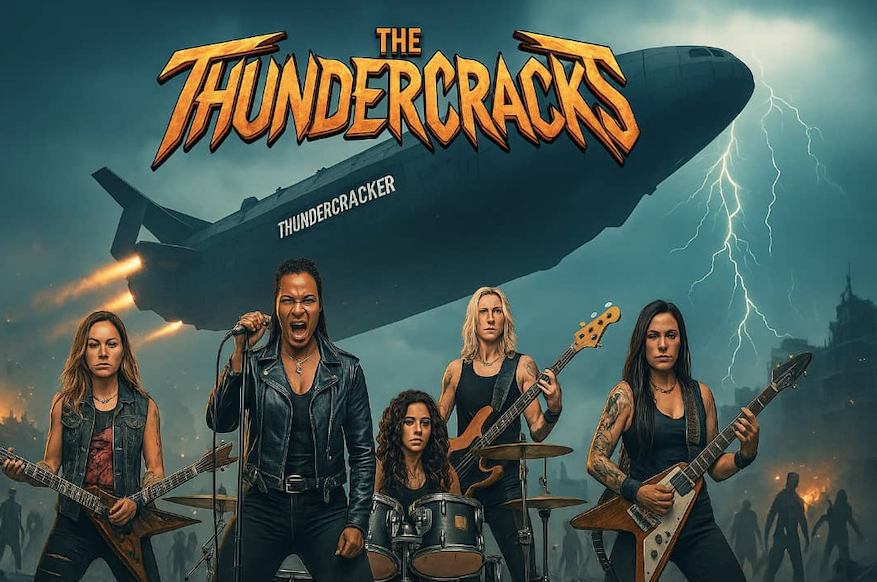
Do you have any special rituals writing music in a zombie infested world?
"Rituals? Well, you can't exactly light candles and burn sage when a horde of undead ghouls are rattling at the barricades, can you? But yeah, we've got our own little process.
For me, it's about the silence. It's a rare and precious thing out here. I'll usually find the quietest, most secure corner of our stronghold—maybe the armory, after we've double-checked the locks—and just sit with my guitar. The low hum of the generators is our new white noise. I close my eyes and try to forget the dust, the rot, and the constant sound of something scuttling in the distance.
That's when the real world fades, and the ideas come. The rhythm of a zombie's stumbling gait can become a bass line. The clang of a scavenged pipe hitting a skull? That's the perfect snare beat. We don't have the luxury of a soundproof studio, so we take our inspiration from the battlefield itself. We're not just writing songs; we're documenting our survival. It's raw, it's real, and it’s the only way we know how."
Are you using your instruments as weapons? What would typically happen if zombies disrupt your rehearsals?
"Weapons? You're damn right they are. This isn't some retro rock show where we just stand there and strum. My guitar, 'Stinger,' has a reinforced neck and a serrated edge. It's perfect for close-quarters combat—a good swing can decapitate a fresh ghoul. Jax's lead guitar, 'Shredder,' has a retractable blade in the headstock. We've all got custom mods on our gear; every piece of equipment has to serve a double purpose. The music is our morale, but the instruments are our survival tools.
As for rehearsals, well, they're more like training exercises with a rhythm section. We never play without someone on watch. If the undead show up, the music stops, and the fight begins. The drums, courtesy of Zoe, are often used to draw the ghouls to a specific area, and we'll use our power chords and feedback to disorient them. Rehearsal becomes a live battle, and we all know our roles. It's loud, it's messy, and it's the only way to make sure we're ready for the next live show—which is just another way of saying the next fight for our lives."
Which band member is most likely to survive a zombie ambush — and why?
Lyra pauses for a moment, looking at the other band members, a small, knowing smirk on her face.
"That's a tough one, because we all have to be survivors. If you're not, you're just another corpse waiting to be reanimated. But if I had to pick one... it would have to be Zoe, our drummer.
Look, the rest of us are all about the front-line fight. Vex and Jax are loud and in your face. Rhea's our anchor, holding down the rhythm and the line. Echo is our eyes and ears, and the one who can manipulate the environment to our advantage. We're all built for a brawl.
But Zoe? She's something else. She's got the brute strength from pounding those drums, but she also has the best sense of timing and rhythm on the team. She can read the ebb and flow of a horde better than anyone. She's not just hitting things; she's calculating every strike, every beat, every moment. When an ambush hits, she's the one who stays calm. She'll be the one to find the weak point in their attack and exploit it. She's not just a drummer; she's a precision instrument of chaos, and that's exactly what you need to survive out here.
She’d be the last one standing, absolutely."
What’s the undead population’s reaction to this release?
Lyra takes a moment, her fingers running over the scarred neck of her guitar as she considers the question, a grim smile playing on her lips.
"The undead... they're not exactly our biggest fans.
It's a strange thing, but the music affects them. Not in the way a lullaby soothes a child, or a rock anthem gets a crowd moving. It’s more… primal. When we kick into a heavy riff, when Zoe's drums are shaking the ground, and Vex is screaming into the mic, it's like a siren call to them. They can't resist it. It draws them in, a hungry, shambling tide. It's why we have to be so careful with our 'releases.' A full-blown show is as much a strategic weapon as it is a performance.
The music doesn't hurt them directly, but it disorients them. The sheer volume and chaotic energy overload their senses—what little they have left. They stumble, they claw at their heads, and they get sloppy. It's a temporary effect, but it gives us the opening we need. That’s when the real show begins. We use the chaos, the confusion, and the sheer number of them as a backdrop for our assault.
So, their reaction? It’s a mix of a mindless, hungry advance and a confused, staggering dance of death. They are our unwitting mosh pit, and we are their executioners. We give them a soundtrack to their final moments, and they provide the carnage for our stage."
With the world in a post-apocalyptic state, how are you reaching the scattered crowd of the living?
Lyra: It's not easy, that's for sure. The old ways of broadcasting are mostly gone, so we've had to get creative. Our signals are broadcast through a network of scavenged radio towers and converted satellite dishes we've patched together. We're essentially pirates on the airwaves, sending out our signal to anyone who has a working receiver.
The "crowd" isn't what it used to be. It's not thousands of people in one place. It's small pockets of survivors huddled together, listening in from hidden bunkers and makeshift settlements. We've heard stories—messages relayed through runners—that our music is a sign of hope for them. That's why we keep playing. It's not just about the show; it's about letting them know they're not alone. The zombies can't stand the frequencies, so our performances also serve as a beacon, a temporary safe zone. It’s brutal, it's loud, and it works.