Artist Spotlight: Meet Tamer Sağcan
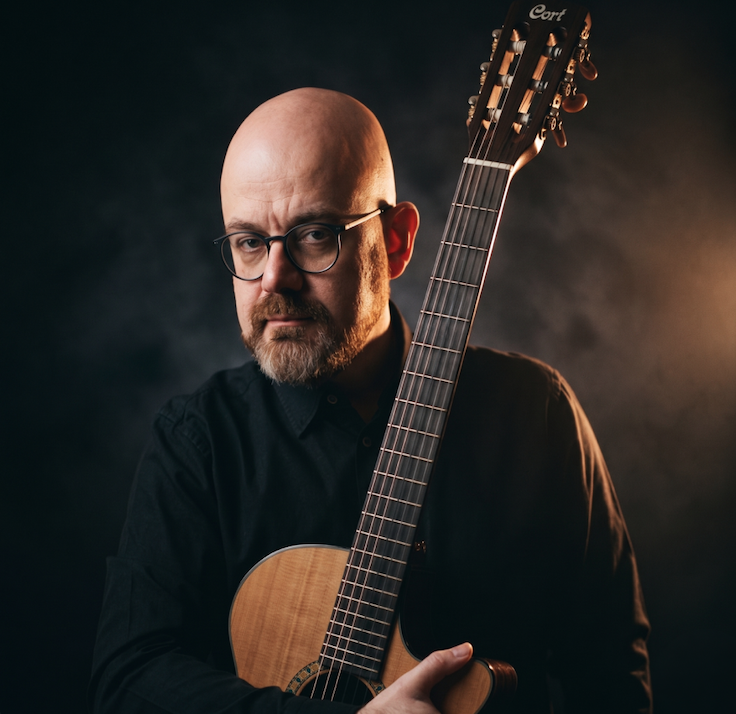
Punk Head: Your work exists across music and a 19-book saga. When you begin a piece, are you thinking like a composer scoring a scene, or like a novelist expanding a world? How do those two instincts interact in practice?
Tamer Sağcan: Honestly, I don't experience them as separate instincts at all and I think that's the heart of how I work. When I write, I'm composing harmony; when I compose, I'm writing narrative. They've been one act for me for a long time.
Even when I structure a book, I'm thinking in mathematical-musical terms, Pascal's triangle, Fibonacci sequences. Chapter divisions, character names, place names: none of them are accidental in my work. Every text I write is, in some sense, a composition; every piece I compose is, in some sense, a novel.
This is why I've come to believe my music belongs to its own kind of category what I sometimes call "narrative music," or what readers of my prose used to call "Sağcanesque." It's not just melody, harmony, and structure. I'm building a language, and my deepest hope is that listeners learn to read it that over time they can hear a piece and visualize what I'm describing, even without words. The book and the music aren't two outputs of one artist. They're two grammars of one language. The Eleyrrha Universe is where they finally speak the same sentence.
Punk Head: The track titles in Home: Universes lean heavily into cosmology. Do you start with the concept or does the music suggest the name afterward?
Tamer Sağcan: The honest answer is messier than either option. These pieces all had names long before they had their current ones, Turkish names, intimate names, sometimes naive names. "Enterstellar" was originally just "Yıldızlar" (Stars). "Eridanus" was "Oblivion." I wrote those titles when I was younger and not thinking about a "release" or a global audience, just about what each piece felt like to me at the moment of writing.
What happened over time was something I didn't plan. As the Eleyrrha Universe grew in my notebooks, I started noticing -almost unconsciously- that my older compositions were already mapping onto events, characters, and atmospheres in that fictional world. It was as if the music had been writing the saga before the saga existed. Instinct, maybe. Or maybe the same internal language was just speaking through both forms.
Before the album came out, I did revisit the names and update some of them, partly to fit the narrative-music framework, partly because cosmological titles let international listeners enter the work without needing Turkish. But the story I was telling through the melody never changed, and the images I see when I listen back to my own recordings never changed either. The music just got a more professional set of names. The interior remained exactly what it had always been.
Punk Head: Home: Roots is intimate and personal, centered on family. Home: Universes expands outward into the cosmic. Is Home: Echoes a synthesis of those two, or does it move somewhere entirely different?
Tamer Sağcan: Echoes is something different and I think that's the answer to the trilogy's secret architecture. Roots was inward; Universes was outward; Echoes is where both directions converge into a third dimension: narrative.
One concrete way it differs is sonic. Roots and Universes are both anchored, in different ways, to my classical guitar. Echoes asks a question I've been quietly avoiding: what happens when the guitar is no longer the center? Of the nineteen tracks on Echoes, seventeen are reimagined covers of pieces from the previous two albums but transformed, expanded, sometimes barely recognizable. Two are entirely new. Together they explore how far the same melodic ideas can travel when given different bodies, different instruments, different visual identities.
I want to be clear about one thing here, because it matters to me: every layer of these compositions, the orchestration, the countermelodies, the textural depth, the way one instrument answers another, comes from me. I'm not a guitarist who hands the rest of the work to a machine. I'm a composer who happens to play guitar. Echoes is, in some ways, the album where I stop letting the guitar speak for me and let the full composition do it instead. The AI helps me realize what I've already written; it doesn't write it.
And here's the part where I either sound serious or completely insane, possibly both: Echoes is a soundtrack for a novel. ANAD, the first book of my nineteen-volume Eleyrrha Universe saga, is being published in August 2026 with Ötüken Neşriyat. Echoes will release at the end of July, just before the book, so by the time readers open the first page, the music will already be living in their ears. Each track is tied to a specific character, place, or mythological figure from the world.
I know how this sounds. Composers don't usually write soundtracks for books that don't exist yet, by authors who happen to be themselves, set in fictional universes they've spent ten years building. But I've stopped pretending this is a normal way to work. If Roots was about the people I love, and Universes was about the cosmos I'm part of, Echoes is about a world I've made and I'd rather give it a soundtrack than apologize for it.
Punk Head: The Altaic concept of a seventeen-layered universe is a fascinating foundation. How literally do you translate that into sound? Are there structural or harmonic systems tied to that idea?
Tamer Sağcan: The seventeen-layered universe in old Turkic and Altaic mythology isn't a literal cosmology I try to reproduce, it's more of a structural sensibility. This is actually a field I've been working in for years. As a lecturer leading workshops on mythology, fantasy, and science fiction in Turkey, I've long argued that mythological structures aren't just old stories but the core of modern creativity. I have a book coming in 2027, -How to Read Myths- where I'll share my own mythology-reading theory developed over the years. So the seventeen-layered universe isn't only an inspiration for me; it's intellectual ground I've been thinking on for a long time.
What I take from that ground into music: the idea that reality has depth, that beneath the visible layer there are other layers operating by different laws, and that an artist's job is sometimes to hint at those without naming them. In practice, this means I think a lot about texture density. A piece will often have a foreground (classical guitar, the human voice of the music), a middle layer (cello or strings, the emotional commentary), and a deeper layer (ambient texture, the sense that something larger is breathing underneath). I don't always succeed, but when a track works, it's usually because I've managed to suggest at least three of those layers without one drowning out the others.
It's not a system I impose. It's a sensibility I trust. The same sensibility runs through the Eleyrrha Universe: nineteen books, seventeen mythological layers, and beneath them all, something else that breathes without being named. I share the same architecture between music and writing because both come from the same world.
Punk Head: The use of AI in orchestration is often controversial. You're very clear about its role in your process. What do you think people misunderstand most about using AI as a creative partner?
Tamer Sağcan: The biggest misunderstanding is the binary itself —the idea that you're either using AI or being authentic, as if those are opposites. The melodies, the compositions, the guitar performances on my albums are entirely my own. Some of them I wrote twenty years ago, with no thought of AI's existence. What AI does is help me realize orchestrations I could otherwise only hear in my head.
For most of my life I had two options: hire a full orchestra (which independent artists like me cannot afford) or leave the music half-finished. AI gave me a third option, and I'm transparent about that because I think transparency is what protects the value of human craft, not silence.
But there's a hypocrisy here I can't pass over. People share their most intimate thoughts, fears, and dreams with conversational AI when they're alone. When I say this, everyone knows exactly what I mean. Then the same people lose their minds when AI enters the music industry, as if music is somehow more sacred than those private conversations. They also act as if they don't know what technical processes a composition, an artist's voice, or instrument sounds go through in today's music industry. Auto-tune, sampling, digital orchestration, entire sonic worlds built through plugins, almost everything in popular music for the last thirty years has passed through these processes. AI is just the latest link in that chain.
The fear is that AI replaces the artist; the truth is that AI just exposes which artists were never doing the human part in the first place. If you bring nothing to the process, AI gives you nothing back.
Punk Head: You've been writing some of these pieces for nearly twenty years. Did revisiting them feel like editing your past self or collaborating with him?
Tamer Sağcan: Collaboration but perhaps in a stranger way than you might expect. I'm going to risk confusing both you and your readers a little here.
Einstein once said that time doesn't only flow from the present to the future sometimes it flows from the future to the past. In my novel, I describe my perception of time not as a straight line, but as a snow globe. We are all like trillions of snowflakes drifting inside that globe and science tells us each snowflake is unique. Inside that globe, sometimes we collide with our future selves, sometimes with our past.
I'm saying this because I can't quite answer the question of "working with my past self" in the conventional sense. Everything I'm doing now -releasing Universes, finishing ANAD, having this conversation with you- was probably what pushed my twenty-years-younger self to compose those pieces in the first place. Maybe the "past me" saved those melodies for me because he knew the "present me" would need them. Maybe those pieces were already written by me, to be released twenty years later. This isn't a mystical claim, it's just leaving room for the possibility that time doesn't move as linearly as most people assume.
So even though my past self can't argue back, saying I'm "collaborating with him again" feels incomplete. Maybe he was always working with me, across all of time. Maybe the reason some of these pieces feel more like mine now than when I wrote them isn't that they were waiting for the rest of my life to happen. It's that they always knew now is when they belonged.
This taught me something humbling: he was already pointing where I would end up going. Or maybe the real question is, who's pointing whom?