Claimove: Artificial Encounters in Jungle City
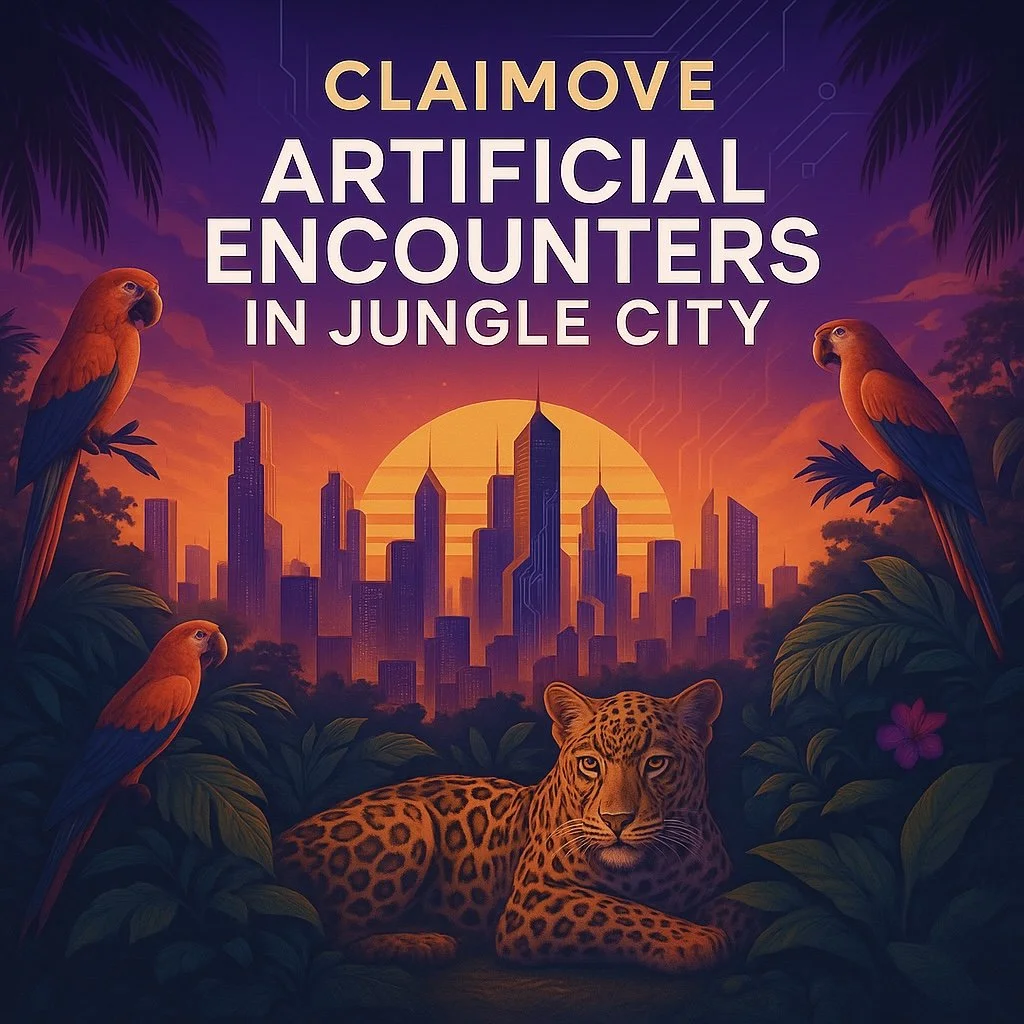
Punk Head: Artificial Encounters in Jungle City follows a journey from natural rainforest to an urban techno-jungle. What inspired that narrative evolution?
Claimove: Well, originally I didn’t set out to create a full album at all. I actually just wanted to craft a single track inspired by something like ‘Didjital Vibrations’ from Jamiroquai’s ‘Travelling Without Moving.’ But you can’t just tell an AI to ‘do it like that.’ I had to tweak and refine the prompts endlessly to get it to head in the direction I envisioned.
It was a long process—hundreds of creations, different styles, and a lot of trial and error. Eventually, I hit on a track called ‘Parrots in the Mirror,’ and that was the spark. Once I had that, I realized I had so many other amazing creations—pop, dance, synth-pop, even EDM influences—that I thought: why not turn it into a whole concept album?
So that’s how the narrative evolved: from that one track into a journey from the natural rainforest to an urban techno-jungle. It’s really about showing that nature and technology don’t have to be at odds. I believe we can find harmony, and that maybe AI can help us live more in tune with the natural world. That’s the vision behind the whole album’s evolution.
Punk Head: The title hints at tension between nature and technology. Do you see this as a warning or a hopeful vision of the future?
Claimove: So in essence, it’s a bit of both. The title definitely hints at that tension between nature and technology. For me, it’s partly a warning because we’re seeing how much of our natural environment we’re putting at risk. But it’s also a hopeful vision. I genuinely believe that with modern technology and AI, we can find ways to live in harmony with nature instead of destroying it. So yes, it’s a balance of both a gentle caution and a bit of optimism for the future.
Punk Head: What character or symbol represents the “soul” of the jungle in your music?
Claimove: For me, the soul of the jungle is symbolized by the parrot. He appears in many of my visuals because he’s colorful, intelligent, social, and full of personality. But more importantly, he reflects something deeply human. Even in our hyper-technological world, we’re not that different from him — we’re curious, expressive, and still searching for connection.
The parrot becomes a mirror: he reminds us where we come from, what we’re in danger of losing, and what still lives inside us. In the album, he represents both the vibrancy of the rainforest and the fragility of our relationship with nature. He’s a reminder that no matter how digital our world becomes, our roots are still wild, emotional, and very real.
Punk Head: You describe AI as an instrument rather than a co-composer. How do you decide when to trust intuition over algorithm?
Claimove: I always say that AI isn’t my co-composer – it’s an instrument. And after creating many thousands of AI generations, something has become very clear to me: AI is like a brilliant nerd. It has scanned millions of data points, books, lyrics, patterns, maybe even half of world literature. But there’s one thing it will never have — the lived human experience.
That’s why intuition always leads. The AI can throw ideas, but I’m the one who decides what becomes music. I feel very quickly when something is truly mine. And the more of myself I give the AI — my own lyrics, my themes, my emotional direction — the better the results become. If I leave everything to the algorithm, the output might be interesting, but it rarely carries real human expression.
For example, the best songs on the album are the ones where I wrote the lyrics myself. The AI can produce ‘okay’ texts, but they don’t replace the depth, nuance, or emotional honesty of a human voice. Still, in the context of this concept — the symbiosis between nature and technology — some AI-driven pieces absolutely earned their place because of their quality.
So yes, AI speeds things up, inspires me, and helps when I get stuck. But the heart of the music — the story, the emotion, the direction — always comes from me. In the end, the human has to remain the decisive factor, otherwise the music loses the very thing that makes it worth listening to.
Punk Head: You built this album largely alone with technology as your partner. Did that feel isolating or freeing?
Claimove: Honestly, it felt incredibly freeing. People often assume that working alone with technology must feel isolating, but for me it was the complete opposite. It was exciting. Creating the album felt like discovering new ideas every single day — the AI throws so many possibilities at you, and you can freely decide what fits your vision and what doesn’t.
And that freedom is what makes the process so enjoyable. If something the AI generates doesn’t feel right, I simply rewrite the lyrics, change the direction, or create new versions until it clicks. Nothing is fixed, nothing is forced. It’s a very playful, creative workflow where I’m always in control.
So no, it never felt lonely. It felt inspiring, fun, and incredibly liberating — a partnership where technology provides endless ideas, and I get to shape them into something that is truly mine.
Punk Head: Your work background gives the rainforest themes real-world weight. What’s one thing you wish everyone understood about preservation efforts?
Claimove: I wish people understood how concrete and immediate rainforest preservation really is. It’s not some distant, abstract project — the loss is happening every single day, and it directly affects our climate, our biodiversity, and ultimately our own lives. These efforts are incredibly important, and they need to move much more into people’s awareness.
With my music, I’m not trying to raise a moral finger. I want to reach people emotionally. That’s why the album is so colorful, so vibrant, so full of contrasts — because music can open doors in a way that facts alone sometimes can’t.
And this isn’t about saving a few trees. It’s about protecting entire ecosystems, natural habitats, and in the end, safeguarding our own future. If my music can contribute even a small part to bringing that message closer to people, then I’m genuinely happy about that.
More From Claimove
Spotify