Hey Gorgeous Turns an Identity Crisis Into a Party Anthem
Punk Head: You describe "Rocker on a Club Run" as the party song on the album, but it also sounds like an existential crisis with a dance beat. Was that always the plan?
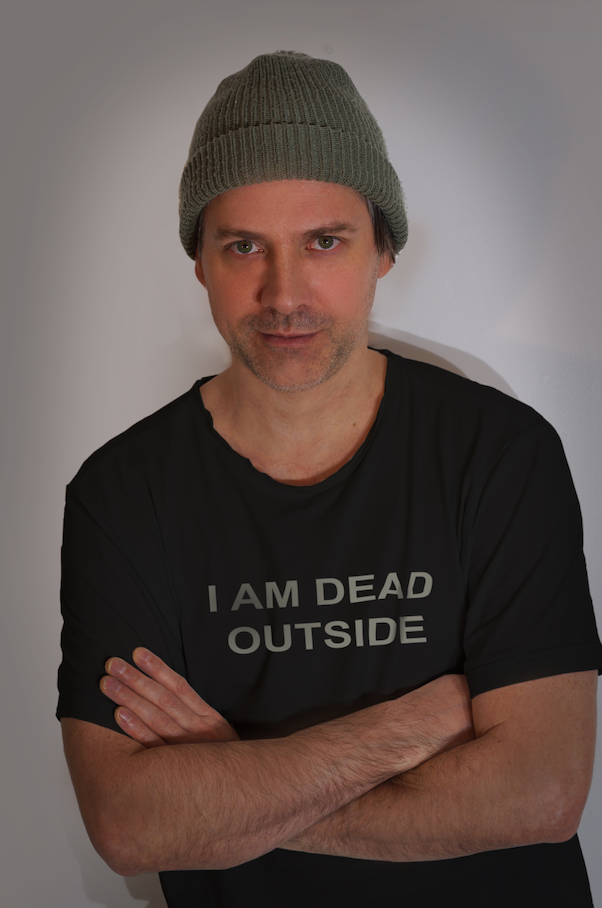
Peet Massé (Hey Gorgeous): Pretty much, yeah. I tend to write very introspective and emotionally charged songs. But I also have a party side, and a taste for things that don’t necessarily match well, at least on the surface. I wanted a song that would address that.
I am a very dualistic person. Most things need to be split in half, then the two halves are compared, analyzed, and put back together. That is my way of understanding and interpreting the world at first sight. This way of investigating things as an artist can be limiting, though, and at some point I had to elevate my approach to something more complex. But I often still start this way. I recently noticed this about myself, and it made me smile. I’ve realized that a lot of things in my life come down to splitting them in two and walking along two parallel lines at the same time. For example, I use the Big Muff pedal on International Breakthroughs for most rhythm guitars and a lot of lead parts as well—except on Rocker on a Club Run, which only features a bit of it in the final guitar solo. But I can’t just use one Big Muff; I need two: a modern USA Big Muff Pi Deluxe on one side of the stereo field and a vintage Sovtek Black Russian on the other.
On my pedalboard, for the upcoming live performances, I run them in parallel. I also use two amplifiers; one dedicated to the Muffs and the other for a clean signal. On the album, I apply the same dualistic approach sonically: mostly rock, but electronic as well; alt-rock/punk on one side and house on the other. The two worlds face each other, blending at times, but mostly remaining in parallel. Since the album addresses a substantial number of topics under a melancholic—and sometimes angry—tone, I felt that including one or two slightly more playful songs would benefit the overall balance. I also wanted at least one track that was neither rock nor house, but a fusion of the two. It ended up in Rocker on a Club Run.
Culturally, I also wanted to explore this dualistic sense of identity I have and express it through the way music genres are tied to social groups. In itself, music doesn’t oppose genres; people do. Rocker on a Club Run addresses that idea as well.
Times are tough, and there are many, many problems in the world. Highlighting this internal “genre conflict” I experience, like an existential crisis, felt a bit absurd—and that's the point.
Punk Head: You frame alt-rock and house as two worlds in conflict. Do you think that divide actually exists, or have we just inherited it?
Peet Massé (Hey Gorgeous): Haha, there’s no such thing, really, until you go to a deep house party and ask the DJ to play a punk rock song. He or she will probably say no, even if they’re wearing a punk rock T-shirt.
Punk Head: The video follows a "fictional version" of you. What could that character do that the real you couldn't?
Peet Massé (Hey Gorgeous): 1) Flirting in bars, nobody really does that anymore. I wish we did.
2) Dancing, following some kind of choreography. I only really drunk-dance occasionally, and even that is happening less and less.
3) Calling out the seriousness of the art world through giant penis artworks. Doing it within a fictional art show inside a music video helps make the art world slightly less offended, perhaps. But who cares, really? I’m not that far from doing it in the real world anyway.
4) Binge drinking over a 24-hour period.
Punk Head: You've spent years building this project while completing a master's degree in the arts. Did academia sharpen your instincts or make you question them more?
Peet Massé (Hey Gorgeous): A bit of both. On the visual art side, I’ve definitely become sharper and more intellectually rigorous. It has also, somewhat ironically, made me an angrier artist. For the past 15 years or so, I’ve been focusing on environmental issues, particularly the decline of endangered species, long before my Master’s degree. I would sometimes approach this subject with irony or humour to contrast with the severity of the situation. It was a strategy of mine. Still, the works remained relatively gentle, at least aesthetically.
Specializing even further in this topic during my Master’s program made me a bit of a science-oriented and politics-oriented art student. Some people used the word “punk” to describe either my work or the work of others in the program. It feels somewhat absurd to use that word in an academic environment, and in the contemporary art world more broadly, which is highly institutionalized. To me, the contemporary art world is anything but punk. Yet the word is still used frequently in the field. It feels very overused and ultimately stripped of meaning. It also disconnects the term from its political anchor.
When you try to engage seriously and honestly with political content, even without any intention of being “punk”, you sometimes encounter institutional gatekeepers who feel the need to test the integrity of your work in all kinds of tedious ways. I suppose it comes with the territory. The Master’s program forced me to sharpen my teeth in that regard.
There is a Japandroids song I love, Near to the Wild Heart of Life, whose chorus goes, “I used to be good, now I am bad.” It resonates with me, haha. I am badder than before. I don’t necessarily channel that directly into my music, but I feel that I will at some point.
Punk Head: There's a recurring idea of creative freedom coming through uncertainty. Was there a moment during the making of this record where uncertainty actually produced a breakthrough?
Peet Massé (Hey Gorgeous): I felt uncertain and insecure throughout the entire process of writing and producing this album. It was a lot of fun, but also pretty challenging. It was time-consuming and came with financial pressures. I was also largely alone in making it, with a few exceptions: recording the drums at Studio Tous les Jours with Mario Telaro and Peter Van Uytfanck, and mastering with Ryan Morey.
Overall, though, it was a fairly solitary process, and being at the center of it forced me to become quite vulnerable to how people might respond to the work. It pushed me into a kind of “I don’t give a fuck” mindset, which I think was ultimately beneficial, except for dating, lol.
I neglected my appearance a bit during that period: not going out much, wearing pyjama pants all the time, letting my hair grow out. I loved it. Not sure the dating apps did.
You have to give it your 200%, without expecting anything other than making music you love and a record you’re proud of. Hard work, passion, and low expectations. The challenges of this process often make you question why you do what you do, and the way you answer that question is what your music ends up sounding like.
In that sense, making this record became a kind of motivational therapy, and I guess also a form of self-growth breakthrough—like most important art projects I go through.