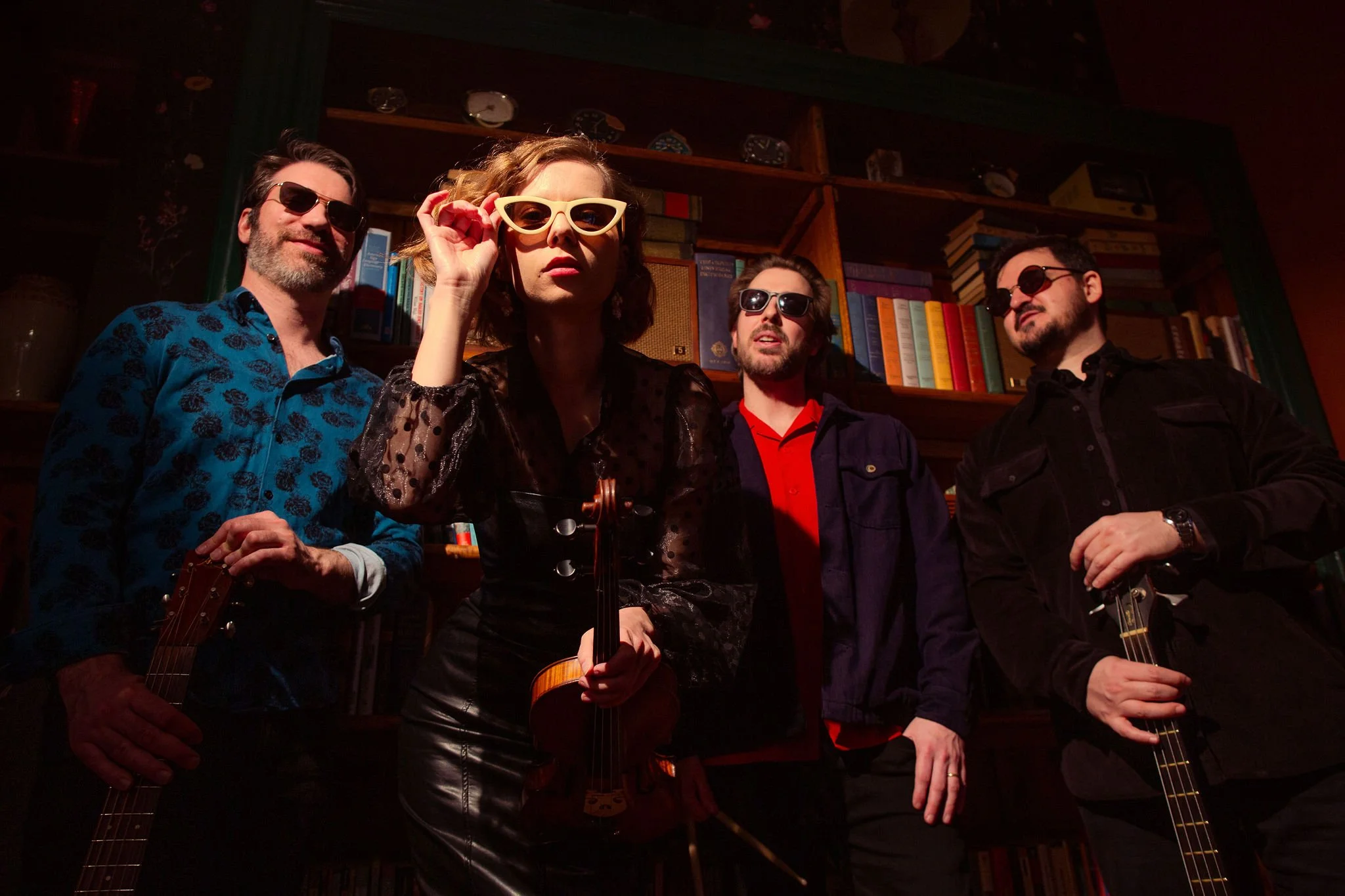
Punk Head: Your version of Baba Yaga is a fiercely independent figure who refuses to play by anyone else's rules. What does she represent to you that a conventional protagonist couldn't, and why does that figure feel relevant to the world you're making music in now?
Fugu Dugu: Bucky Wanko and the Legend of Baba Yaga is a wild musical journey through the darker corners of Eastern Europe, where Soviet-era absurdity, Balkan madness, punk, and gypsy jazz collide. Imprisoned in a Siberian gulag for a crime which he did not commit, Bucky escapes into the frozen tundra, and is saved by Baba Yaga, a supernatural witch with a taste for the blood of authoritarians. Sustained on herring, beets, pickle juice, and vodka, Bucky embarks on a delirious adventure across borders, cultures, and musical genres.
Baba Yaga is the remnants of a woman living in the Siberian Tundra who had her family taken away. Now she roams the land as a supernatural spiritual force with a razor sharp fingernail and her own sense of justice.
Why is she important now? Our world is filled with disinformation, artificial intelligence, and constant bombardment with junk food information that only leaves us wanting more. Humans are so disconnected from the mystical, and yet they are drawn to it through movies and books.
This song is an exercise in breaking as many traditional rules in songwriting as possible.
1) avoid cliches (see: “forest through the trees”),
2) avoid tritones (known as the devil’s triad), and
3) avoid overly complex melodies (Rasputin quoting Mussorgsky over a Chopin melody)
The song Baba Yaga is an exercise in breaking all those rules…with a funky chorus and meaty bass, of course.
Punk Head: Klezmer, Eastern European folk, Americana, and punk all have their own histories and musical rules. When you bring them together, how do you decide what to preserve, what to disrupt, and what you're happy to throw out entirely?
Fugu Dugu: There was a time when folk music was new and revolutionary. Woody Guthrie, Pete Seeger, and Phil Ochs were considered enemies of the state. Modern humans deserve their own folk music.
Thus, we write Klepto-Folk. If a song needs a piece from somewhere, we take it. If you steal from enough sources, you eventually get something very different.
We aren’t trying to preserve anything. There is a place for reverence and preservation. It is not with Fugu Dugu.
Punk Head: Olya, you come from a classical violin background, while Bucky's songwriting leans into poetry, storytelling, and absurdity. Can you describe a moment when your different instincts fundamentally changed a song, taking it somewhere neither of you would have reached alone?
Fugu Dugu: Our take on “Mama Tried” is a perfect example of how sometimes I can’t hold back the classical persona. In typical Bucky fashion, he made a song in a major key minor, and I found it a perfect place to insert one of my favorite violin showpieces, “Zigeunerwiesen” by Pablo de Sarasate. It fit like a glove. Although, maybe my college violin professor would disagree.
Punk Head: The Bucky Wanko mythology combines political oppression with underground performances, folklore, and absurdity. How do you use humour to approach serious subjects without making them feel trivial, and can silliness itself become a form of resistance?
Fugu Dugu: The 70s and 80s Punk was originally about rejecting authority and corporations. The Boogeymen included Margaret Thatcher, Ronald Reagan, Big Banks, and Pepsi Co. Our boogeyman is complacency and mindrot through technology that is designed to make humans miserable. The folks at the top want us stuck in our living room, glued to our TVs and phones, and in constant fear and anxiety.
Joy is resistance. Creating art is resistance. You should be dancing.
Punk Head: Your music draws on traditions with deep cultural histories, but the experience you seem most determined to create is a room full of people dancing. Do you see that as a way of keeping those traditions alive, transforming them into something new, or creating a kind of temporary community that doesn't need everyone to share the same background?
Fugu Dugu: Kurt Vonnegut said it best: “Music is, to me, proof of the existence of God. It is so extraordinarily full of magic, and in tough times of my life I can listen to music and it makes such a difference.”
There is a reason why nearly all authoritarian regimes put restrictions on music. The tradition that needs to be kept alive is bands writing songs about their life experiences and then playing to an audience. That tradition is so critical to the human condition, and it cannot be replicated with AI.