The Controlled Chaos Behind Aux Volta’s ‘Ouroboros’
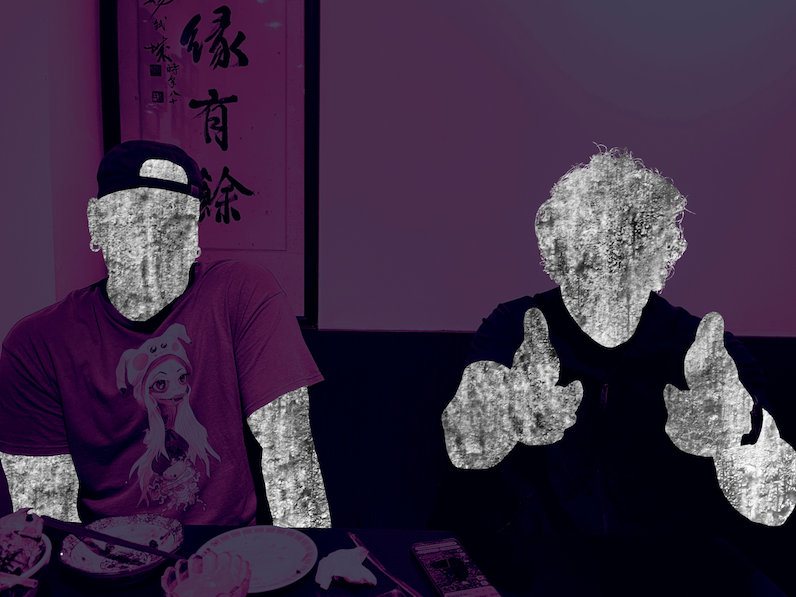
Punk Head: Your visual collaborator CER translates glitch and loop into 3D space. Did his approach influence how you structured the track, or vice versa?
Volta: The track was made first, CER produced the visuals to match the track’s energy, pace and vibe. The Muzak outro was something that happened due to the collaboration.
CER: The visual art I developed for this track is a personal interpretation of the song as a set of elements, from the fundamental concept of the OUROBOROS taking into account its symbolism, the loop as a representative element of life's journey, with all that can influence that process that ultimately ends in the same place, life is death and vice versa.
This concept is interpreted under the suggestion that this song produces in me, the beats, the asymmetrical rhythm and the temperature of the sound are what end up giving the aesthetic and the timeline of the whole piece.
In this piece, I was able to merge hand-painting for the creation of all the textures and maps that were later used digitally on the final result.
Aux: I’d like to add that what CER has managed to do, it really took us both by surprise in so many ways. For me, most importantly, when he first showed us what he was working on there was such an earnestness behind the work - as he’s already described, he really wanted to resonate with the audio and he wanted us to know the depth to which he had gone. And you can tell… he’s gone so deep!
Punk Head: Your music is described as a “science experiment with feelings.” How do you reconcile technical aggression with emotional resonance in your compositions?
Volta: Playing a traditional instrument is a tactile, intuitive experience; once the mechanics are mastered, you stop thinking about the process and simply emote. While producing electronic music via a DAW is arguably more complex than plucking a string or slapping a bongo, the psychological threshold remains identical. By treating MIDI controllers, drum pads, and software interfaces as direct extensions of ourselves, the technical layout becomes invisible. Once the tools are second nature, we just 'ride the machine' in real time, fusing technical aggression with genuine emotional resonance.
Where traditional instruments offer predictable, instant, intuitive emotion, our creative process actively embraces calculated chaos and gamification to completely remove the ego and force weirdness. We developed bizarre rules and algorithmic prompting systems to dictate our direction. For example, we used random number generators to pinpoint a specific page, paragraph, and word in a physical book. That keyword was fed into our custom program to scrape its corresponding Wikipedia articles, converting that data into strict instructions governing our time signatures, BPMs, and the precise intervals for switching laptops.
We also built a program capable of generating thousands of different structural rules and restrictive prompts, forcing us to "only work on a synth line" or find and utilise a highly specific sample. To complement this, we frequently used simple, everyday objects like dice, cards, and coins to make chaotic, creative decisions on the fly.
This extreme, volatile experimentation covers the 'science experiment' side of our music; it feels inherently Frankenstein-esque to bring music to life by playing with such intricate, exotic processes. Yet, it doesn't matter if you start the chain with a pristine sine wave or a sample of a horny capybara; you can always use an array of effects and processing to mould and shape that sonic material until it matches the pulse of your heart and the rhythm in your brain. Ultimately, we achieve emotional resonance by treating these rigid, chaotic parameters as a challenging game, forcing a raw human reaction out of cold data. Paraphrasing what Robert Moog famously said about feeling the energy flowing through his synthesisers and adjusting the knobs: it is about manipulating the circuitry to capture true, instinctive human feeling.
Aux: There’s a lot of what Volta says that I’d echo. An angle I’d add is that both of us are quite confused humans in our daily life. Maybe our music is mirroring, somewhat, the same type of reconciliation we both actively are attempting in life. We’re all sort of walking science and psychological experiments, with deeply flawed emotional cores… aren’t we?
Punk Head: CER’s visuals are influenced by abstract graffiti, physical textures, and architectural glitches. What parallels do you see between your sound design and his visual processes?
Volta: I met CER a long time before we collaborated on this music video, we instantly clicked over a number of topics, such as art styles, graffiti, skating, psychedelics, tbh i’m still not sure exactly how much we share musically, but I know we both love “Maggot Brain” (Funkadelic) - and that goes a long way in my book. I’ll let CER and Aux explain further….
Aux: What a question! This isn’t something I’ve had a chance to discuss, or even share, with CER or Volta yet, but I think that whilst there is a fundamental difference in our approaches, there has still managed to be symbiosis and narrative that extends between the two.
That main difference is that CER is one person whilst Volta and I have each other. So our process bounces around and changes quite a bit. We not only second guess ourselves but we have another person to second guess our second guesses!
Maybe I’m reaching, or romanticising as I reach, but I’d like to think there is a kinship in how CER thinks about his visuals, and how we think about our sound. When Volta and I think about sound, it’s often more about the impact that sound will have on the rest of the piece. It seems obvious, but when working on a sound piece it sort of exists in a timeless state - with an ability to jump back and forth on the timeline. I feel like our way of constructing audio leans heavily into a constant state of re-interpretation. As the audio reveals itself, it evolves. And I feel like CER’s piece also resonates in that way. A collaging of ideas, and then sculpting and taking a step back, sculpting some more and taking another step back.
Maybe! CER?
CER: Indeed, as a creative, visual artist, and designer by profession, throughout my 20+ year career I've developed certain ways of approaching each project I undertake.
This is all based on specific methodologies and something fundamental: believing in the process.
For me, everything begins with a key concept that gradually passes through a filter composed of all the pre-loaded influences in my mind, which unconsciously shapes the result for each piece of visual art I make, like a sculpture.
I must say that I've always been a passionate follower of art in all its manifestations, and the spectrum of my influences, both musical and visual, is quite broad. Basically, it's composed of everything that awakens that indescribable feeling in me. And yes... it's a big “collage”.
A playful way to describe it would be something like: seeing a punk rocker and a hippie dancing salsa with Le Corbusier at a rave... or something like that...hahahaha…
Aux: Haha! Nice.
Punk Head: Your work resists categorization and mainstream imagery. How does your deliberate anonymity or absence from social media feed into your creative process?
Volta: Ah, small correction, we yielded and folded. We now have an insta, @auxvolta (“Smash dat like buddon!!!)... but do not expect to see any selfies or BTS there any time soon, or ever - Aux Volta is music, weird processes and crazy visuals first. It’s not that we are camera shy, we just don’t think it’s important to show ourselves. At the same time, it’s not a secret who we are. If you see us at a show, come up and chat, we highly value personal connections and face to face interaction.
We’ve always written very prog/abstract/experimental “music”, perhaps to a fault. A lot of people who love music, even experimental enthusiasts, usually want something at least vaguely familiar, easier to digest. The album (Complex Solutions for Simple Problems We Do Not Understand) goes out of its way to carve an uncharted, sometimes difficult sonic path. The follow up album however, is going to be something a bit more recognisable and category friendly; Korals will be less genre-fluid :)
Aux: Our social presence is something we talk about a lot internally. We actually have very similar perspectives on social media platforms, but completely different approaches. I don’t mind voicing that I hate almost everything about social media and I don’t try to cultivate a social media presence in any way. My anonymity, both inside and outside of Aux Volta, is very much tied to my creative process, insofar that for me, thinking about social media deadens my creativity. I don’t have a love-hate relationship with it, there is no love. I do use it to connect with people, push other projects, and share about myself, but it has always, from DAY 1, given me the ick. You can actually tell from our answers which one of us is actually going to help get Aux Volta out there (thank you Volta).
Anonymity, when it comes to the outward presence of the project, perhaps feels safest. A lot of the music I’ve fallen in love with, I’ve fallen in love with it without images, without wider context or who the people are. Mystery and anonymity allows me to stay in this suspended space of appreciation of just the music. In today’s world it often feels like you have to put the ‘person’ forward before the music. It’s all ‘behind-the-scenes’ videos, guitarists sitting in sunny rooms by windows with plants singing their songs, or producers showing off their fancy equipment with one or two cables trailing off camera. The visual image is so neatly and intentionally curated. But what was once honest has become a bandwagon and everything is a copy-and-paste of itself.
Damn… I’m ranting.
Volta: I think Aux is hungry, he could do with Ploughman’s.
Aux: I’ve wanted a ploughman's, so many times.
Punk Head: Living and working between multiple continents, how does this displacement shape your sense of identity, audience, and the sonic languages you draw from?
Volta: We aim to do as much of the creative process in person as possible, and mostly use online meets for catch ups and admin. I would say displacement at least for me was necessary to find my preferred geolocation aka ‘happy place’ on God’s green flat earth.
Aux: It’s changed the way we’ve had to work, and what Volta is also talking about is a very impactful and real thing. When you’re living a creative life and pursuing a personal creative project, it is almost impossible to separate your actual life, feelings, emotions, from your work. Not being able to find your ‘happy place’ is going to affect even wanting to make music in the first place. So in one very real sense, all of our music is in some way influenced by us having to find ways to keep working together across remote distances.
Though, that being said… we also force ourselves into silly creative situations, like “we’ve only got 13 minutes to write a drum beat but we can only use sounds of birds, and we can only operate the machine using our non-dominant hand”. It’s really silly, it’s almost a game or challenge. A lot of our music has come to existence with these types of beginnings.
At first it was just fun and something different to do, but over the years of doing this, we’ve stumbled into something quite useful, because what this is great at doing is getting rid of things like emotional baggage, emotional states, and (conveniently) ego. Being in a country away from home, where everyone speaks in a foreign language, this is, without a doubt, isolating. Doing things like making randomised interventions through challenging and nonsensical rules, it sort of tricks the brain into focussing entirely on trying to complete the challenge rather than worry about whatever is going on in our lives. “What? I’ve got 6 minutes to write a bassline using sellotape and my mobile phone?! Okay, I’ll tell you about my shit day later on!”
Now that we’ve both sort of settled in our respective territories, I think we’re drawing a bit more from the local environments with regards to sounds and people. There’s music we’re working on now that feels much more like it could only happen because we are in these new territories.
Volta: Aux makes really good points! It’s true that some of the field recording / sampling we do are very unique to the location in which we create at the time, as such the location can have a heavy impact on the music we create there. Also the live instrument and vocal recordings really help cement a memory of what track or element was created where.
It’s trippy to think about it now, despite both of us already living in our respective new countries (Taiwan and Thailand), we actually started and completed this entire album in London, UK on trips when we were both doing “home” visits to our respective families and friends. Conversely the follow up album was started online, really fleshed out in Ayutthaya, Thailand and near-completed in Changhua, Taiwan, we probably need one more session to complete it, where that happens depends on what number we roll on the die.
I can’t write anymore now, as my timer has just sounded. It's the end of my turn, I have to put down the aubergine I was using to tap the keyboard with.
Aux: There’s a part of the question about identity too? What do you think Volta? Has displacement shaped your sense of identity?
Volta: Difficult to say, I’d have to meet alt universe me who never left the city that was causing immense frustration. Being nomadic and travelling charges my creative batteries, I’m also a strong believer that a better world comes from understanding one another, what better way then travelling and mixing? I don’t think learning about culture and people is possible through propagandist media.
Punk Head: There’s a tension in “Ouroboros” between infinite looping structures and raw, chaotic energy. Was that tension deliberate, or a byproduct of the experimentation?
CER: Well, for me, the song clearly tells a story from beginning to end, going through all its stages; the beginning becomes the end and vice versa.
The nature of the loop, traveling from that feeling of tension to decompression and release, is like a rubber band.
As for the atmosphere, I think at first glance everything seems more chaotic than it actually is, the structure within the asymmetry—my goal was to translate that feeling through an abstract representation, obviously filtered through my sense of aesthetics, with color and form determined to accompany the musical atmosphere.
Aux: It’s kinda nice to know that there is both deliberate and accidental tension. I like how CER describes it as a rubber band because that same object can exist in a state of rest or one of extreme tension, which is sort of how I feel about this track - same object, different states of tension. It’s also interesting to me that when I think about the musical aspect of it, being one half of the maker, I see it as being very controlled and organised. I know the track intimately because I was there with Volta piecing it together. But, when I look at CER’s visuals, I’m so far away from that process so I get to see the chaotic beauty of it all.
Volta: You are most correct to pick up on tension! I’m not sure how much I should divulge about that. But what I can say is that without considerable amounts of tension… this track would not exist as it is!