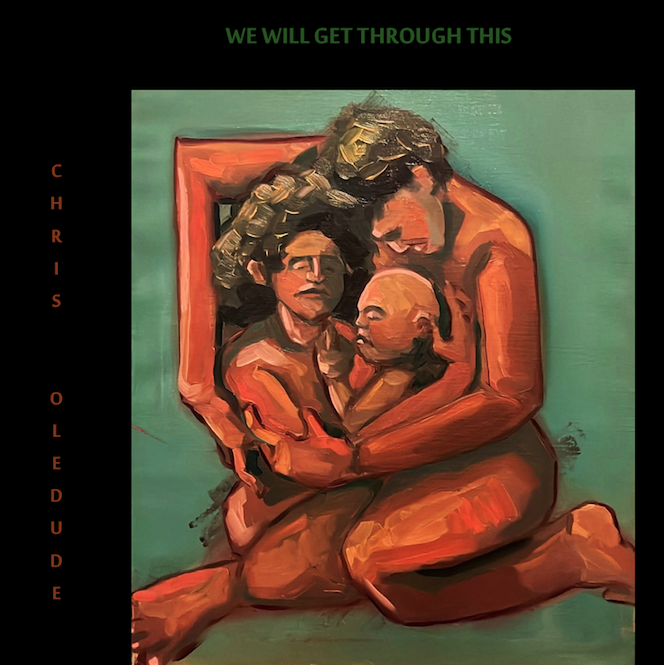
Chris Oledude: “WE WILL GET THROUGH THIS”
Punk Head: How did your collaboration with Yanitza Lee first come about, and what made you realize she was the right voice for this song?
Chris Oledude: Yanitza and I met in 2023. I put together a show featuring my songs as a celebration of Dr. Martin Luther King’s birthday holiday and, as part of my 16-piece ensemble, I needed a chorus! I asked around amongst my musician friends and got names, of which Yanitza was one of two sopranos. I loved her voice then and decided that I would work with her again one day. This year, as I put together my album, I decided to create “We Will Get Through This” as a duet. I auditioned several people and it was very clear that Yanitza’s voice had the lightness and purity that I was looking for. This song is NOT an easy song to sing. The melody moves between octaves and the breathing is challenging as well. I admit that I struggled at points, so I had to select a key that worked for me first – and then I prayed that it would work for the other singer. Fortunately, Yanitza rose to the occasion – as did her voice!
(By the way, I had a similar great experience with another vocalist from that 2023 performance, Kiena Williams, who is my duet-mate on the song “If A Woman Had Made The World.”)
Punk Head: You’ve described “We Will Get Through This” as inspired by simple childhood songs and classic pop duets — what elements of those influences did you hope listeners would feel?
Chris Oledude: I wanted this song to be “memorable” and, for most of us, the first songs we learned as children are the most memorable. The basic melody in the verses is short, simple and repeats – a characteristic of many children’s songs. In fact, the melody is simpler than many children’s songs. The chorus is a sequence of two very straightforward arpeggios, even though they are demanding ones. On the other hand, the song’s bridge and the call-and-response break invoke pop songs and provide that opportunity for the back and forth of a Motown duet, for example.
As a songwriter, I try to honor the great music that serves as a set of constant reference points – whether folk, classical, pop or funk. I don’t want my songs to sound “just like everyone else’s”, but it is often very humbling to struggle through the creative process when you tend to compare your work to that of others.
Punk Head: The song now reflects a broader global need for unity and healing. At what moment did you realize it had grown beyond its original purpose?
Chris Oledude: America’s Presidential election of 2024 was that moment. I was devastated – as were so many people around the world – by the re-election of Donald Trump. There was a sea of trauma and despair that threatened to envelope so many of us.
I had started to map out my album. I have a number of songs that were competing for slots and I knew I needed at least one ballad. In January of this year (2025), the Presidential Inauguration was the catalyst for selecting “We Will Get Through This”, because that is what I kept telling myself.
Punk Head: On your album PREACHER MAN – VOL. 1, “We Will Get Through This” is the sole ballad. Why was it important for you to include a song centered on tenderness and care?
Chris Oledude: My intent in building the album was to inspire and motivate action. A call this work “the soundtrack of democracy’s comeback”. We know, however, that human beings cannot keep pushing themselves without breaks to replenish their energy, refocus their intentions, and heal from any damage endured during the journey.
I have a problem with any social movement that overlooks the challenges of “being human”. It does not matter if you are on the right or left side of the political spectrum or if we disagree on issues; if you cannot respect my humanity, then I will have a hard time working with you. So, this song is a reminder that each of us has turmoil in our lives and choices to make – and each of us needs other people in our lives to make it through life.
Punk Head: After creating such a healing-focused song, has it changed how you think about your responsibility as a songwriter?
Chris Oledude: Not really. My first responsibility as a songwriter has always been to listen to the world around me and feel the tensions and resolutions in people’s lives – particularly my own. My second responsibility is to present my perspective on the world and hope that it resonates with others.
These are the two reasons why it has been almost impossible for me to write songs designed for commercial consumption; other than the musical arrangements, my creative process does not start “in the club”, for example. These are also the reasons why I welcome the opportunity to collaborate with lyricists (like I did with another song on this album, “Turning Tables”). It’s necessary to get out of one’s own head on occasion and force yourself to try new things. Finally, the responsibilities mentioned above do allow me to consider writing purely instrumental pieces as well. Words can be constraining.