Inside Katie Noir’s 23-Song Journey Through What Is Unseen Still Exists
Punk Head: The title, What Is Unseen Still Exists, feels less like an album title and more like a philosophy. When did that idea first become something you wanted to explore through music?
Katie Noir: I think it really is a philosophy for me, not just an album title. I can’t say the exact moment anymore, because the phrase has been with me for such a long time. When I was younger, I became interested in the idea that not everything real has to be visible. I remember reading about Plato and his Theory of Forms, the idea that the physical world we see might only be an imperfect reflection of something deeper, eternal and unseen. That thought stayed with me.
Over time, I started applying it to almost everything. Feelings can be unseen, but still completely real. Love can be unseen. Grief can be unseen. Memories, regrets, hope, loneliness, friendship, so many of the things that shape us most are things nobody can physically point at. Just because something is hidden, quiet or difficult to explain does not mean it does not exist.
That idea became very personal to me when I was younger. I was a very introverted and thoughtful kid/teenager and I did not have many real-life friends at the time. So I spent a lot of time on an online chat website and that is where I met some of the people who became deeply important to me, including Lisa, Lexi and Sara.
On that website, everyone could put a little thought or phrase under their name. Mine was always: “What is unseen still exists”
At the time, I don’t think I fully understood how much that sentence described me. I just knew it felt true. It was almost like a quiet way of saying: there is more inside me than people can see.
While the album was slowly growing song by song, Lisa actually said to me: “Why don’t you use that as your album name?” And the moment she said it, something clicked immediately.
Suddenly the whole album made sense under that title. These songs were all about hidden emotions, old memories, private regrets, friendships, apologies, dreams and parts of myself I never really knew how to explain out loud.
So the title came from my childhood, from philosophy, from my inner world and also from the people who helped me understand myself better. That is why I even wrote a song with the same name. It became the heart of the album.
So yes, thank you, Lisa. 🖤
Punk Head: Why was a 23-song concept album the right way to introduce yourself as an artist?
Katie Noir: A 23-song concept album felt right because I never wanted to introduce myself with just one side of me.
Even as a listener, I have always been drawn to music with meaningful lyrics, songs where the words carry weight, where one line can stay in your head for days and make you think about your own life differently. For me, a song should not only sound good; it should mean something. I love when music has a story, when it makes you feel something in your bones.
That is also how I naturally started writing. The first full songs I finished were not created as singles or as a strategy. They began as an apology to my friends. I was trying to explain things I had never been able to say properly in person. From there, each song became connected to another moment, another feeling, another event in my life. Slowly, the album became almost like a diary.
At some point, I realized these songs were not separate anymore. They belonged to one emotional timeline. So I started organizing them into chapters and arcs, almost like a novel or a film. There was the mask, the friendships, the belief, the everyday life, the darker parts and finally the meaning behind everything.
I know 23 songs is a lot, especially for a debut album. But for me, telling this story properly needed space. I love long albums and extended songs because they allow you to breathe inside a world. A concept album should not feel rushed. If everything is too fast or too shallow, there is no room for the listener to discover the little connections, symbols, contradictions and emotional details.
The number 23 also became very important to me. I have always loved that number and I also remembered the film *The Number 23* with Jim Carrey, which plays with obsession, patterns, and hidden connections. That idea really clicked with the album. I decided to build a small mythology around the number 23, not in a heavy or forced way, but as a thread running through the project. That is why there is also a song called Number 23, which connects many of the pieces together.
I think I am probably a songwriter and storyteller first. I have always dreamed of creating a connected concept album full of little riddles, double meanings, emotional callbacks and songs that feel like they are speaking to each other.
So for me, 23 songs was not about making the album bigger just for the sake of it. It was about giving the story enough room to exist.
Punk Head: You write that music allows you to express things that are difficult to say in everyday life. Did creating this album help you understand yourself differently, or did it simply give shape to feelings you already knew were there?
Katie Noir: I think it was both.
Some feelings were already there and music gave them a place to go. For me, writing songs can feel almost like opening an emotional valve. There are things I carry around quietly for a long time and when I finally turn them into a song, it feels like I have spoken them out loud without actually having to sit in front of someone and explain everything directly.
Listening back to those songs afterwards often gives me peace. It releases something. It makes the feeling less chaotic, because suddenly it has a shape, a melody, a structure, a beginning and an ending. It is still emotional, but it is no longer just floating around inside me.
But the album also helped me understand new things about myself.
One thing I learned is that I can be more direct than I thought. Some songs are soft and vulnerable, but others allowed me to bring out a much more sarcastic, sharp and honest side of myself. That surprised me in a good way. Songs like that gave me a kind of satisfaction, because they let me point at things I find wrong, unfair, fake or ridiculous and say it clearly.
I think I used to hide a lot behind overthinking and politeness. Through the album, I realized that honesty can also be creative. It does not always have to be quiet or fragile. Sometimes it can be funny, angry, dramatic or brutally direct.
So yes, the album gave shape to feelings I already knew were there, but it also showed me parts of myself I had not fully accepted before. It taught me that Katie Noir is not only sadness or vulnerability. She can also be sarcastic, observant, stubborn, playful and unafraid to say when something feels wrong.
That was important for me, because the album became not only a way to explain myself to other people, but also a way to meet myself more clearly.
Punk Head: Because this album follows a narrative arc, did you think about it almost like writing a novel or a film? Were there recurring characters, symbols, or emotional motifs that helped tie everything together?
Katie Noir: Yes, absolutely. I thought about the album very much like writing a novel or a film.
I love when songs have more than one layer. I do not want them to only exist for a few minutes and then disappear. I like when a lyric, a symbol or a character returns later and suddenly means something different. That is what makes music exciting to me, when a song is not only a song, but part of a larger emotional world.
So while creating *What Is Unseen Still Exists*, I was very conscious of building a narrative arc. The album starts with the mask: sarcasm, defensiveness, humor, anger and the way someone can hide pain behind attitude. Then it slowly opens into friendship, attachment, memories, everyday life, emotional collapse, reflection and finally meaning.
There are recurring characters, especially the people who became important to the story. My friends, Lisa, Lexi and Sara are not just names in songs. They represent different kinds of connection: loyalty, warmth, misunderstanding, comfort, distance and the strange way people can shape your life even when they are not always physically there. Their presence helps make the album feel less like a fictional story and more like my diary with people I know walking through it.
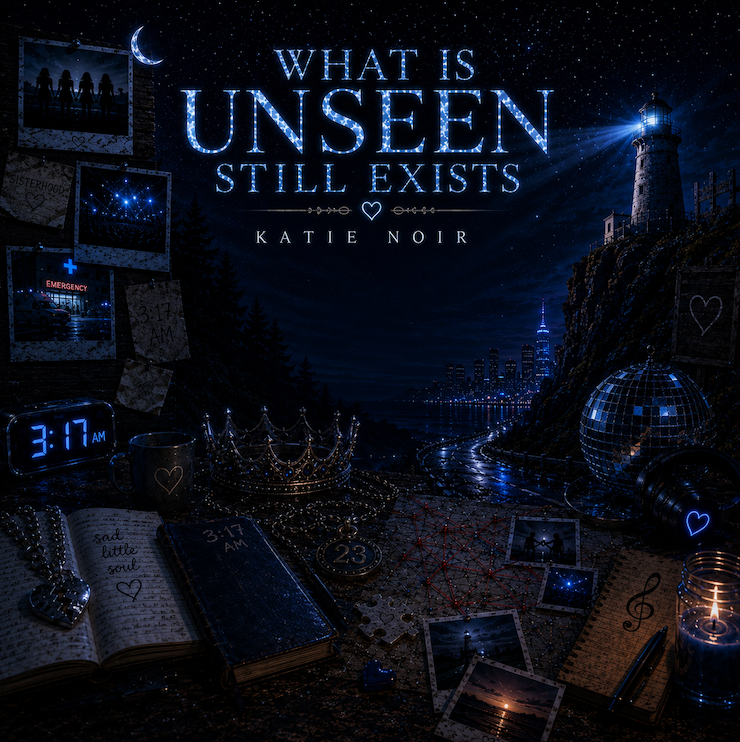
There are also recurring symbols. The mask is one of the most important ones, because so much of the album is about what people show versus what they hide. The crown appears as a symbol of pressure, identity, fragility and trying to hold yourself together even when you feel cracked. The number 23 became another thread, almost like a hidden code running through the whole project. It connects the album length, the release date, the song “Number 23,” and the idea that patterns can appear everywhere when something means enough to you.
Other motifs return too: night, roads, hospitals, dorm rooms, music, old messages, distance, friendship, overthinking and the feeling of being seen only in pieces. I wanted the listener to feel like they were moving through different rooms of the same inner world.
That is why the album needed chapters for me. Each chapter has its own emotional color, but they all belong to the same story. Some songs are funny and sarcastic, some are vulnerable, some are dark, some are hopeful, but they all circle around the same question: what do we carry inside that other people cannot see?
For me, that is the purpose of the album. It is not just a playlist of songs. It is a connected story full of memories, symbols, little riddles, emotional callbacks and moments that only fully make sense when you experience the whole thing.
That is also why the number 23 felt so right. It became the frame around everything, not only a number, but a way to tie the story together.
Punk Head: At 21, you're reflecting on identity, mistakes, resilience, and meaning with remarkable scope. Did writing these songs feel like documenting your experiences, or were you also imagining the person you hope to become?
Katie Noir: Most of the album comes from my own experiences or from emotions and situations I could imagine myself going through very deeply.
Some songs are directly connected to real people and real parts of my life, especially the songs about my friends and my student life. Those were very much about documenting what happened, what I felt, what I regretted, what I admired and what I never managed to say properly at the time.
Other songs come more from emotional imagination. For example, songs like Relapse or some of the more sarcastic tracks are not always literal diary entries in the same way, but they still come from real feelings, fears, observations and parts of myself. Sometimes I write about something because I have lived it. Sometimes I write about it because I am afraid of living it or because I see it around me and need to make sense of it.
So yes, the album documents who I am right now, but it also reaches toward the person I hope to become.
I am very aware that I am not perfect. I still have many things to learn and sometimes writing these songs made that painfully clear to me. But I think that is also why I needed to write them. The album became a way to look at my mistakes, my values, my contradictions and my hopes without running away from them.
At the end, I hope to become someone who stands for the things I believe are morally right: compassion, honesty, loyalty, responsibility and the idea that people can become better if they are willing to reflect on themselves. I know that may sound idealistic, but I do believe humanity can be better than it currently is.
That is why meaning matters so much to me in music. I do not only want to describe pain or confusion. I want to ask what we can learn from it. I want songs to give people something to think about, maybe even something that slightly changes how they see themselves or other people.
So in a way, *What Is Unseen Still Exists* is both a diary and a compass. It shows where I have been, but also points toward the kind of person I am still trying to become.